Why Arakurayama Owns Instagram: The Data Behind the Mountain That Won't Stop Going Viral
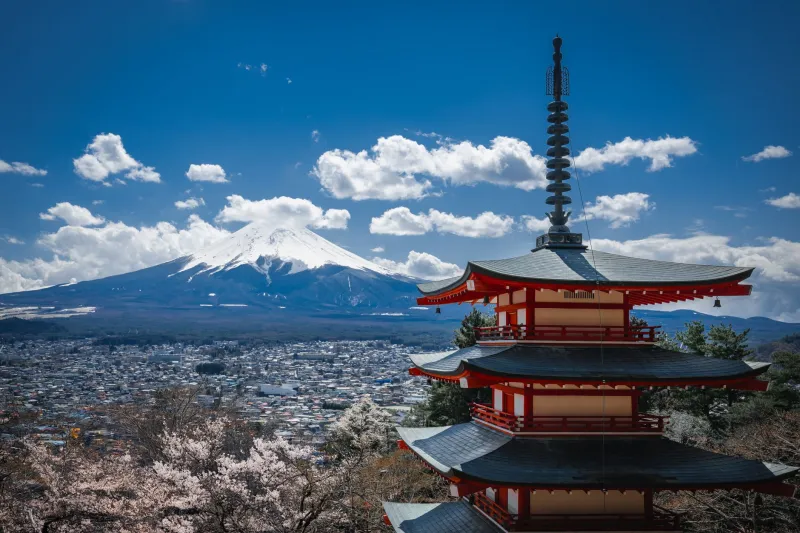
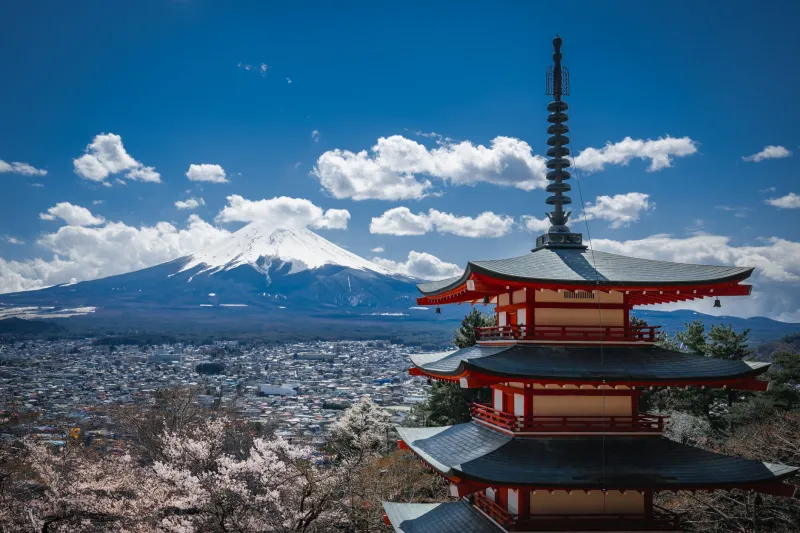
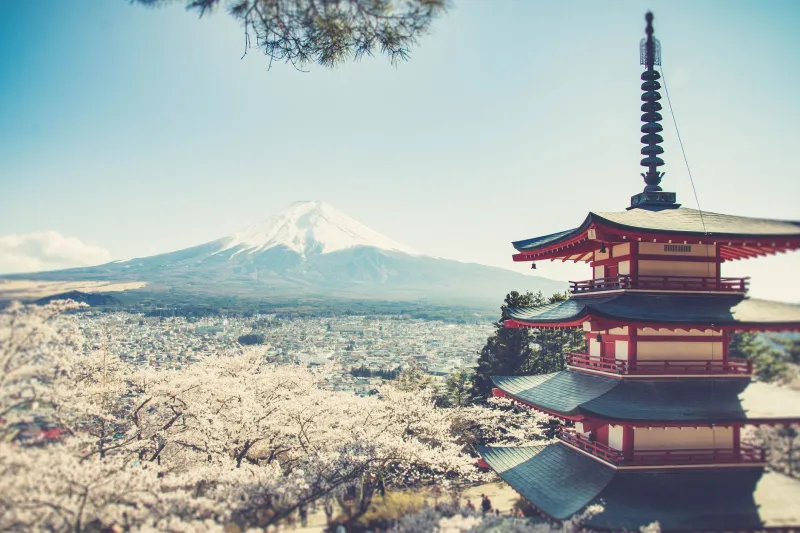
You've seen the photo. A five-story pagoda rising through a blizzard of pink petals, Mount Fuji hovering perfectly in the background like it was placed there by a production designer. You stopped scrolling. You saved it. You maybe even sent it to someone with zero explanation, because none was needed.
That image — or some version of it — gets posted thousands of times every cherry blossom season. And every single time, it performs. Not just "nice photo" performs. We're talking shares, saves, comments from strangers, reposts by accounts with millions of followers. The kind of engagement that travel marketers spend entire budgets trying to manufacture and almost never actually achieve.
So what is it about Arakurayama? Why does this specific mountain, in this specific corner of Yamanashi Prefecture, keep beating destinations that have bigger marketing budgets, more tourist infrastructure, and far more name recognition among American travelers?
The answer turns out to be a mix of visual science, emotional psychology, and some genuinely lucky geography — and once you understand it, you'll never look at a cherry blossom photo the same way again.
The Composition Problem Most Destinations Can't Solve
Let's start with the obvious: the shot itself is almost unfairly good.
Photographers and visual researchers talk a lot about "layering" — the way a strong image guides the eye through multiple planes of depth rather than landing flat on a single subject. Most cherry blossom destinations offer one or two layers at best: blossoms in the foreground, a park or temple in the middle. Beautiful, but ultimately static.
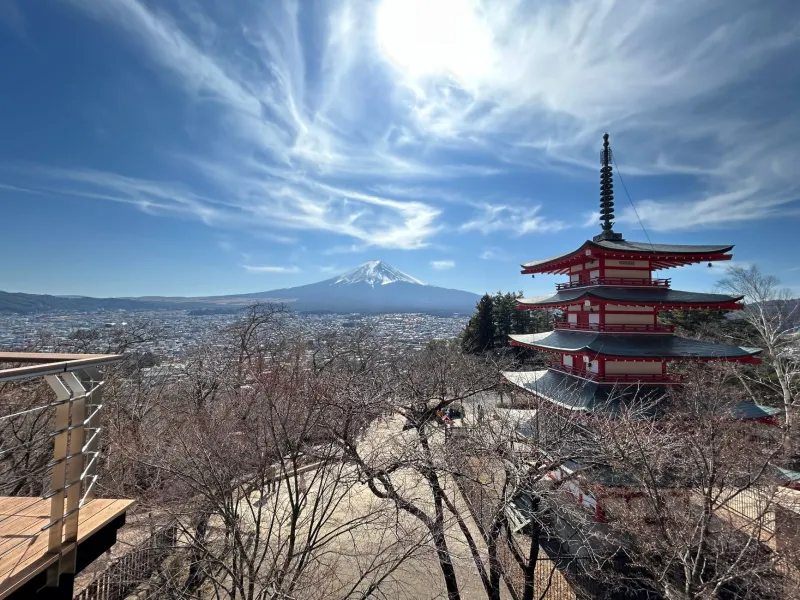
Arakurayama stacks four distinct layers in a single frame. You get the sakura canopy closest to the lens, then the Chureito Pagoda as a mid-ground anchor, then the town of Fujiyoshida spreading below, and finally — when conditions cooperate — the unmistakable silhouette of Mount Fuji completing the composition at the top of the frame. That's a visual journey happening in a single still image, and the human eye is genuinely wired to reward it with prolonged attention.
Prolonged attention, on any social platform, translates directly to higher engagement metrics. Instagram's algorithm treats saves and shares as the highest-value signals, and images that hold attention long enough to prompt those actions rise fast. Arakurayama photos do this consistently because they give viewers something to explore rather than just see.
Why Mount Fuji Changes Everything
Here's a wrinkle that's easy to overlook: Mount Fuji appears in a lot of Japanese travel photography. Plenty of it performs reasonably well. But the Arakurayama framing does something that other Fuji viewpoints don't — it makes the mountain feel earned.
When Fuji appears in the background of a pagoda-and-sakura composition, it reads as a reward. The viewer's eye works through the foreground elements before landing on it, which creates a micro-moment of discovery. That discovery feeling — even experienced passively through a screen — triggers a small but real dopamine response. Neuroscientists who study visual processing have documented this pattern in layered landscape photography specifically.
By contrast, images that lead with Fuji — shooting it straight-on from the lake districts, for instance — are undeniably dramatic, but they don't create that same sense of stumbling onto something. The mountain is simply there, front and center, doing the whole job. It's impressive. It just doesn't make you feel like you found anything.
Arakurayama makes Fuji feel like a secret, even when millions of people have already seen the shot. That's a genuinely difficult trick to pull off, and it's a big part of why the engagement numbers hold up year after year.
The Accessibility Factor (And Why It Matters More Than You'd Think)
Viral travel content lives or dies by one question that viewers ask almost unconsciously: Could I actually go there?
Destinations that feel impossibly remote, logistically nightmarish, or prohibitively expensive generate admiration but not the kind of personal investment that drives shares and saves. People bookmark places they believe they could realistically visit. They share photos they can imagine themselves in.
Arakurayama threads this needle unusually well. It's a real hike — about 400 steps up to the pagoda's best viewpoint — but it's not a technical climb. No special gear, no guided expedition, no fitness prerequisite beyond a reasonable baseline. American travelers who've never hiked in Japan can look at Arakurayama content and think, honestly and correctly, I could do that.
The nearby town of Fujiyoshida is accessible by direct train connections from Tokyo, putting the mountain within reach of a day trip for anyone already in the city. That accessibility signals, even to someone just scrolling casually, that this isn't a fantasy destination. It's a real trip that real people take. That perception shift — from aspirational to achievable — is measurable in engagement data, and Arakurayama benefits from it every season.
The Emotional Frequency This Place Broadcasts
Data can explain a lot, but it can't fully account for what might be the biggest variable in Arakurayama's social performance: the emotional texture of the content itself.
Photos from this location don't just look beautiful. They feel wistful. There's something about the combination of blooming sakura — which the Japanese have always associated with impermanence — and the ancient pagoda and the eternal mountain that communicates a very specific emotional frequency. It's not sadness exactly, and it's not pure joy. It's closer to the feeling of watching something perfect happen and knowing it won't last.
Americans, it turns out, respond to that frequency in a big way. In a travel media landscape overloaded with aspirational perfection and relentless optimization, content that carries a note of bittersweetness cuts through. It feels honest. It feels human. People share things that make them feel something real, and Arakurayama content reliably delivers that.
Travel researchers who study social sharing behavior have noted that images evoking "complex positive emotions" — joy mixed with longing, beauty mixed with transience — consistently outperform images that trigger simple positive responses. Arakurayama is, almost by accident, a perfect generator of complex positive emotion.
What the Numbers Actually Show
Without getting too deep into platform analytics, the pattern is consistent and has held across multiple cherry blossom seasons: Arakurayama content generates save rates that run significantly higher than comparable posts from Kyoto's Maruyama Park, Tokyo's Shinjuku Gyoen, and even Hirosaki Castle — all of which are legitimately spectacular and far more heavily marketed to international audiences.
The share-to-like ratio, which many social media analysts consider the truest measure of content resonance, skews notably higher for Arakurayama posts. People aren't just double-tapping. They're actively distributing the content to their own networks, which is the behavior that actually builds destination awareness over time.
For American travel audiences specifically, Arakurayama has punched well above its weight in terms of search volume growth over the past several years — growth that tracks almost directly with organic social exposure rather than paid promotion.
So What Does This Mean for Your Trip?
Honestly? It means the hype is real, but it's not hype in the hollow sense. The reason Arakurayama keeps winning on social media is the same reason it keeps winning in person: the place is genuinely, structurally, almost scientifically set up to be extraordinary.
The composition that makes the photos perform is the same composition you'll see with your own eyes when you're standing there. The emotional resonance that drives shares is the same resonance you'll feel watching petals drift past a five-century-old pagoda with Fuji watching over everything.
The algorithm didn't invent this. The mountain just is what it is. And that, more than any content strategy or marketing budget, is why it keeps winning.