One Look Is Never Enough: The Strange Pull That Keeps Drawing Visitors Back to Arakurayama
Most travel experiences follow a predictable arc. You plan the trip, you show up, you take the photos, you go home satisfied. Maybe you'll return someday, maybe you won't. It's a clean transaction.
Arakurayama doesn't work that way.
Ask anyone who's made the climb to Chureito Pagoda during cherry blossom season and they'll tell you something a little hard to explain: the experience doesn't really end when you leave. It lingers. It resurfaces. And before long, you're Googling bloom forecasts for next April like it's a perfectly normal thing to do.
So what's actually going on here? Why does one mountain — one specific combination of stairs, sakura, and sky — create such a persistent gravitational pull?
The Setup That Should Not Work This Well
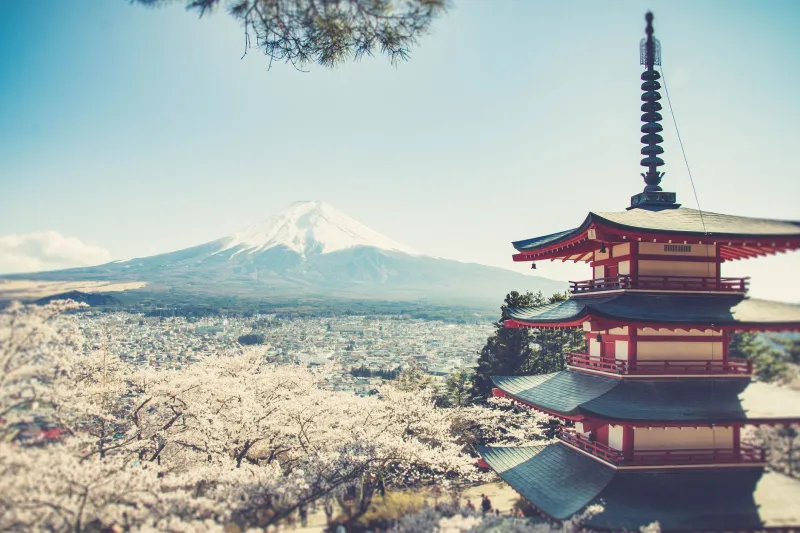
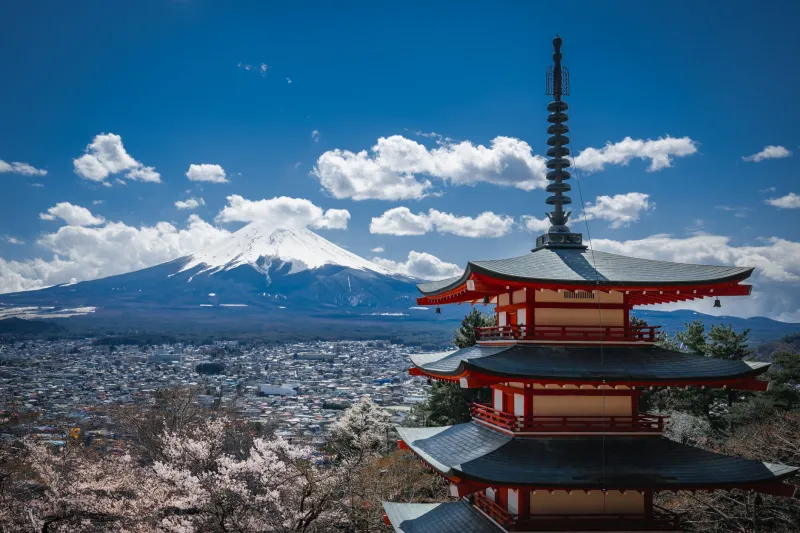
On paper, Arakurayama is almost comically straightforward. You hike up roughly 400 stone steps. You arrive at a five-story pagoda. You look out at Mount Fuji framed by cherry blossoms. You take a breath.
That's it. There's no immersive technology involved. No curated soundtrack. No branded experience. Just altitude, architecture, and trees doing what trees do every spring.
And yet, that simplicity is precisely the point. Environmental psychologists have long argued that "restorative environments" — places that genuinely reduce cognitive fatigue and produce feelings of awe — share a few consistent traits: they feel vast, they feel coherent, and they feel just slightly beyond full comprehension. Arakurayama checks every single box.
The view from the pagoda isn't just beautiful. It's almost too much to process at once. Mount Fuji in the background. The town of Fujiyoshida below. Hundreds of cherry trees in simultaneous bloom. The pagoda itself as a foreground anchor. Your brain is working hard just to take it all in, and that effort — counterintuitively — feels wonderful.
Why Your Memory of the Place Is Never Quite Accurate
Here's where it gets interesting. Talk to repeat visitors and a theme emerges almost immediately: they came back because their memory of the first visit felt incomplete.
Sarah M., a landscape photographer from Portland who has visited Arakurayama three times in four years, puts it this way: "I remembered it as beautiful, but when I got back the second time, I realized I had actually forgotten how beautiful it was. Like my brain had stored a lower-resolution version of it."
That's not just poetic — there's real cognitive science behind it. Research on "peak experiences" suggests that emotionally intense moments are encoded differently than ordinary memories. They're vivid but also somewhat unstable, subject to compression over time. The emotional intensity gets preserved; the specific sensory details fade. What you're left with is a strong feeling attached to an incomplete picture.
That gap between the feeling and the faded details is exactly what drives the urge to return. You're not chasing novelty. You're chasing fidelity — trying to close the distance between what you remember feeling and what you can actually recall seeing.
The Role of Seasonal Timing in Creating Urgency
Not every beautiful place creates this kind of pull. Part of what makes Arakurayama different is that its peak experience is genuinely time-limited in a way that most destinations are not.
The cherry blossom window at Arakurayama is roughly one to two weeks long, depending on the year. Miss it by a few days in either direction and the view is pleasant but not transformative. That narrow window isn't just a logistical constraint — it's psychologically significant.
Scarcity, as any behavioral economist will tell you, amplifies perceived value. But at Arakurayama, the scarcity isn't manufactured. It's seasonal and real and completely indifferent to your schedule. The mountain doesn't care when your PTO resets. The sakura blooms when it blooms.
That combination of high emotional reward and limited availability is almost a textbook formula for compulsive revisitation. You want to go back partly because you can't be sure you'll time it perfectly again — and partly because you know that if you do, it'll be worth it.
What Repeat Visitors Actually Say
Talk to the people who keep coming back and the reasons are remarkably consistent, even across very different types of travelers.
Dave K., a software engineer from Austin who made his first visit solo and has since returned with his wife and then again with his teenage kids, describes it as "the one place where I feel like I showed up at exactly the right moment in the world." He's not talking about personal timing. He means the feeling that the mountain itself is doing something rare and you happened to be there for it.
That sense of witnessed rarity is a big part of the Arakurayama paradox. Even though millions of people visit during peak bloom, the experience doesn't feel crowded in the way that phrase usually implies. The scale of the view absorbs the crowd. You're aware of other people but not diminished by them.
For Megan T., a middle school teacher from Chicago who has visited twice and is already planning a third trip, the pull is more personal: "I'm not the same person I was the last time I went. I want to see what I notice differently now."
That's a genuinely sophisticated way to think about repeat travel — not as redundancy but as a kind of personal benchmark. Arakurayama becomes a fixed point against which you measure your own change.
Altitude, Effort, and the Reward Chemistry of the Climb
It's worth pausing on the physical dimension of the experience, because it matters more than people expect.
You don't drive to the Chureito Pagoda viewpoint. You climb to it. Around 400 steps, gaining real elevation, with the view revealing itself gradually rather than all at once. By the time you arrive at the top, your heart rate is up, your legs know they've done something, and your brain has been primed by physical effort to receive the view as a genuine reward.
This isn't incidental. Exercise — even moderate exertion like a sustained stair climb — triggers endorphin release and increases dopamine sensitivity. You're chemically more receptive to positive stimuli when you're mildly winded than when you're standing still. The mountain essentially doses you before it shows you the view.
That neurochemical setup is part of why the experience hits so hard on first visit, and part of why the memory of it stays warm and vivid for so long afterward. Your body remembers the effort. Your brain remembers the reward. The combination is surprisingly hard to replicate.
The Paradox, Plainly Stated
Here's the thing about Arakurayama: it satisfies completely in the moment and leaves you wanting more the second you're gone. That's not a contradiction — it's actually a sign of genuine quality.
Most travel experiences that leave you wanting more do so because they underdelivered. Arakurayama does the opposite. It delivers so fully, so specifically, and so briefly that the experience becomes a standard you keep trying to return to.
You go back not because the first time wasn't enough. You go back because it was exactly enough — and that feeling, once you've had it, becomes something you want to find again.
The mountain will be there next spring. The sakura will bloom in its narrow, indifferent window. And if you've already made the climb once, there's a reasonable chance you already know you'll be back.