Why Every Travel Algorithm Gets Arakurayama Wrong — And How to Plan Around That
If you've ever tried to book a cherry blossom trip to Arakurayama using one of those "best time to visit" tools — the kind that spits out a tidy green-yellow-red calendar — you've probably noticed something frustrating: the data feels confident in a way that the mountain itself refuses to be.
Arakurayama doesn't care about your algorithm. And the more you understand why, the better your trip is going to go.
The Forecasting Problem Nobody Talks About
Most travel planning tools pull from historical averages. They aggregate past visitor counts, cross-reference flight search volume, factor in hotel pricing trends, and output a "sweet spot" window. For a lot of destinations, this works reasonably well. Arakurayama? Not so much.
The bloom timing at Arakurayama — and across the broader Fujiyoshida area of Yamanashi Prefecture — is driven by a layered set of meteorological variables that don't average out cleanly. Dr. Kenji Watanabe, a climate researcher affiliated with the University of Yamanashi who has studied Fuji Five Lakes regional weather patterns for over a decade, puts it plainly: "The interaction between cold air descending from Mount Fuji, the thermal behavior of the Fuji Five Lakes basin, and year-to-year variation in winter precipitation creates bloom conditions that resist simple modeling."
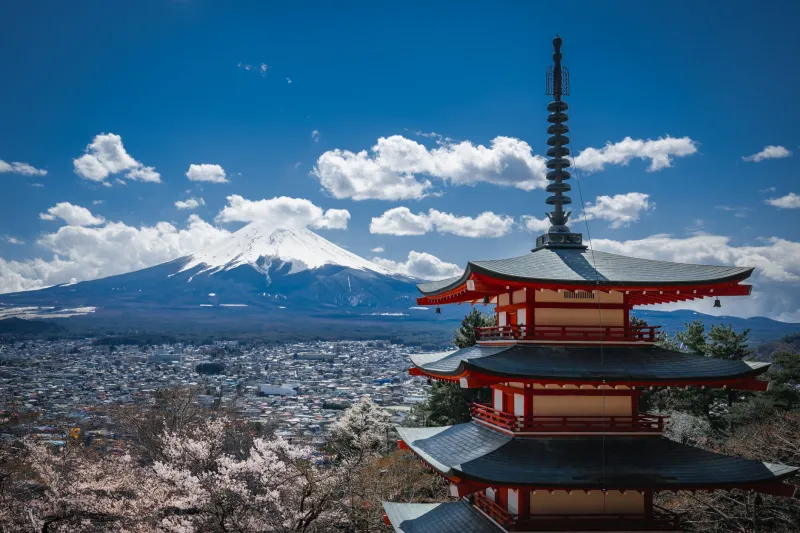
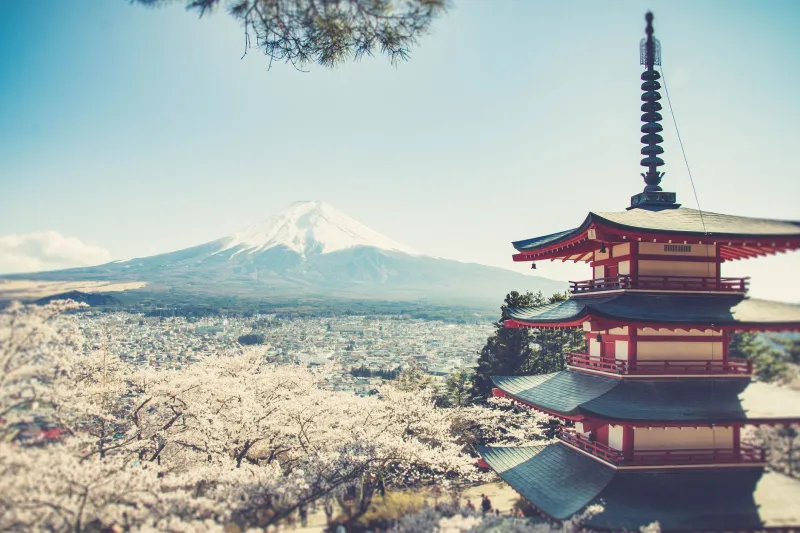
In practical terms, that means the cherry blossoms at Chureito Pagoda — the shot everyone wants — can peak anywhere from late March to mid-April depending on the year. That's not a narrow window. That's a three-week uncertainty band that breaks most standard booking strategies.
Visitor Flow That Doesn't Make Sense on Paper
Here's where it gets even stranger. You'd expect Arakurayama to follow a standard tourism bell curve: crowds build toward a peak, then taper off. Instead, travel analysts who study Japanese domestic tourism have noted something more erratic happening at this particular site.
Jamie Okonkwo, a travel demand analyst based in Seattle who consults for several Asia-focused tour operators, describes what he calls the "Fuji framing effect." Because Arakurayama's most iconic view — the pagoda, the blossoms, Mount Fuji in the background — is so specifically photogenic, visitor behavior clusters around image-making conditions rather than bloom conditions alone.
"People aren't just chasing peak bloom," Okonkwo explains. "They're chasing peak bloom and a clear Fuji sighting and the right light. So you get these weird micro-surge days when all three align, and then relatively quiet days right next to them even during the same bloom week."
This means the crowd prediction tools that work beautifully for, say, Kyoto's Maruyama Park — which has consistent, readable visitor patterns — fall apart at Arakurayama. A Tuesday can be more packed than the surrounding weekend if Mount Fuji decides to show itself that morning.
Why American Visitors Are Especially Vulnerable to Bad Data
For US travelers, the stakes of getting this wrong are higher than for domestic Japanese visitors. You're not hopping on a two-hour train from Tokyo on a whim — you've booked international flights, probably taken time off work, and built an itinerary around a specific window. The psychological pressure to "get it right" is real.
And the tools most Americans use to plan — Google's popular times data, TripAdvisor seasonality graphs, even some of the Japan-focused travel blogs — are working from datasets that don't capture Arakurayama's actual behavioral patterns. They're smoothed, averaged, and often several years out of date in terms of how climate shifts are affecting bloom timing.
The Japan Meteorological Corporation, which provides the country's most widely cited sakura forecast, has publicly acknowledged that prediction accuracy has decreased over the past decade as warming trends introduce more year-to-year variability. What used to be a five-day bloom window is sometimes now a ten-day spread with a softer peak.
Working With Uncertainty Instead of Fighting It
So what do you actually do with all this? A few strategies that experienced Arakurayama visitors swear by:
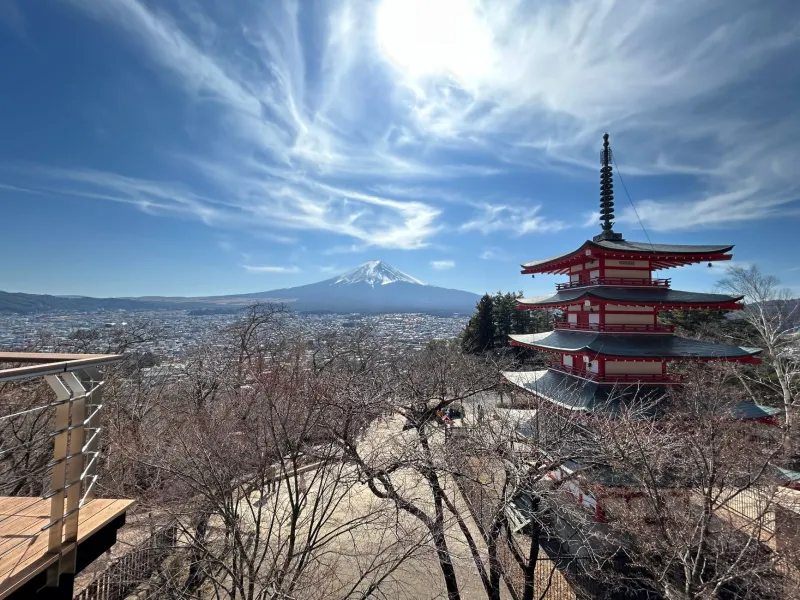
Build in buffer days. If you can only visit Japan once and Arakurayama is a priority, don't schedule it as a single-day side trip. Give yourself two or three mornings at the mountain. The climb to Chureito Pagoda takes under 400 steps and about 20-30 minutes — it's not a commitment that requires a full day. You can do it, come back, and try again when conditions shift.
Watch the Japan Meteorological Corporation's sakura forecast directly. Their site (in Japanese, but Google Translate handles it fine) updates weekly as spring approaches and daily once blooms begin. It's far more granular than anything an English-language aggregator will give you.
Follow local social accounts. The Fujiyoshida Tourism Board and several Yamanashi-based nature photographers post real-time bloom updates during the season. A quick Instagram search for #新倉山浅間公園 (Arakurayama Sengen Park) sorted by recent will show you what the mountain looked like this morning.
Don't anchor on a single "ideal" date. The visitors who leave Arakurayama most satisfied tend to be the ones who arrived with loose expectations and let the mountain show them what it had. The ones who leave disappointed are usually those who planned around a specific date six months in advance and refused to adjust.
Embrace the pre-peak and post-peak windows. Arakurayama's microclimates — the way the mountain's elevation and Fuji's shadow affect different sections of the trail — mean that even outside the official peak bloom days, you'll find something worth seeing. Earlier in the season, the lower sections bloom first. Later, the upper slopes hold color longer. The algorithm doesn't account for any of that.
The Deeper Point
There's something almost philosophically interesting about a place that resists data-driven optimization. Most of modern travel planning is about eliminating uncertainty — finding the perfect window, the best price, the least crowded hour. Arakurayama pushes back on all of that.
The mountain's unpredictability isn't a bug. It's a feature that keeps the experience from being fully commodified. You can't automate your way to the perfect morning at Chureito Pagoda. You have to show up, be flexible, and accept that the mountain will decide what it shows you.
For Americans used to itineraries that run on rails, that's an adjustment. But the travelers who've made peace with it — who've learned to treat Arakurayama as a place to meet rather than a destination to conquer — tend to describe their visits in terms that no algorithm could have predicted either.
Some things still require showing up and seeing for yourself.