Arrive Before the Crowds Do: Timing Your Arakurayama Visit Like a Pro
Everybody wants to be there for peak bloom. That's the goal, right? Full trees, maximum color, the whole mountain draped in pink. And sure, peak bloom at Arakurayama is genuinely spectacular — nobody's going to tell you otherwise.
But here's the thing experienced sakura travelers figured out a long time ago: the week before peak bloom is often the smarter play. Lighter crowds, more predictable weather, and if you know what you're looking for, you'll arrive just as the mountain is hitting its stride — not after it's already been trampled by everyone else who had the same idea.
Timing a trip to Arakurayama isn't guesswork. It's a skill. And it's one you can actually learn.
Understanding How Bloom Forecasting Works
Japan takes its cherry blossom forecasting seriously in a way that genuinely has no American equivalent. Multiple meteorological organizations — including the Japan Meteorological Corporation — publish bloom prediction maps starting in late January each year. These forecasts are updated regularly as spring approaches and are based on accumulated temperature data, historical patterns, and real-time weather readings.
The key metric is something called the "sakura front" — a wave of bloom that moves northward across the country as temperatures warm. In a typical year, the front reaches the Yamanashi Prefecture area (where Arakurayama sits) in late March to early April. But "typical" is doing a lot of work in that sentence. Warm winters push the timing earlier. Cold springs push it later. Some years the difference from historical averages is ten days or more.
Bookmarking a reliable forecast site in January and checking it weekly through February and March is the minimum investment serious visitors make. By early March, most forecasts are accurate enough to start making real decisions.
What "The Week Before" Actually Looks Like
Here's what you're walking into if you arrive five to seven days before peak bloom.
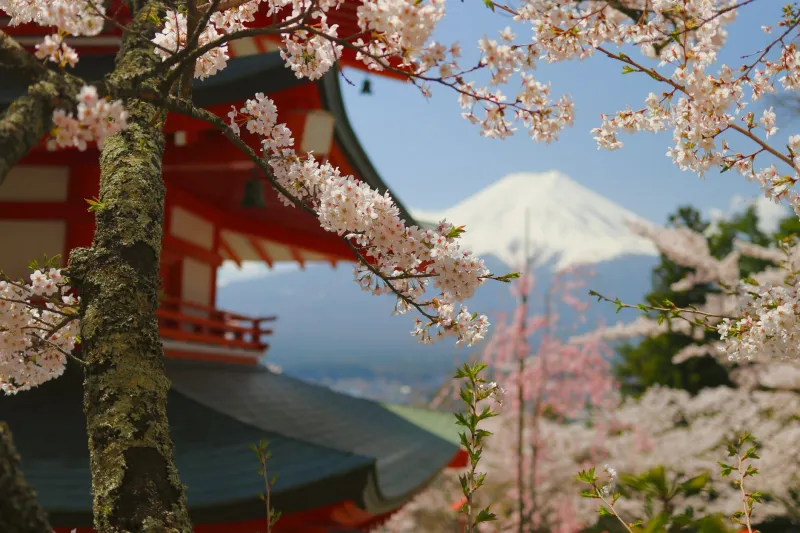
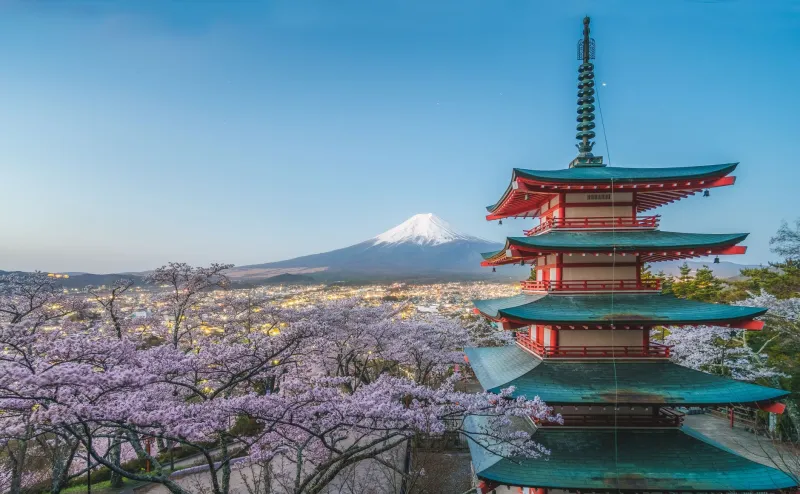
The trees will be in what's called "kosan" or early bloom — roughly 20 to 50 percent of blossoms open. At Arakurayama, that translates to trees with patches of vivid color against still-visible branches. The mountain looks alive and dynamic rather than the uniform pink cloud of full peak. Honestly? A lot of photographers prefer this stage. The variation in the canopy creates depth and texture that a fully saturated bloom doesn't have.
Crowds are noticeably thinner. Not empty — Arakurayama is never truly empty during sakura season — but manageable in a way that peak weekend crowds are not. You can actually stop and look at things. You can get a photo without waiting for a gap in foot traffic. You can sit at the pagoda and just exist for a few minutes without feeling like you're holding up a queue.
Weather also tends to be more stable in the days leading up to peak than during and after it. Peak bloom coincides with the period when spring storms become more frequent in Japan. The week before is often cleaner, calmer, and better for visibility — which matters enormously when Mount Fuji is supposed to be in your frame.
How to Read the Real-Time Signals
Bloom forecasts give you the framework. But the last few days before you book that final leg of your trip, you want ground-level intelligence.
A few reliable sources:
Local social media. Search Japanese Instagram and Twitter (X) for posts tagged at Chureito Pagoda or Arakurayama. Japanese visitors post obsessively during sakura season, and their photos will tell you exactly what the trees look like right now, not what a forecast thinks they'll look like in four days.
The Japan Meteorological Corporation's Sakura Map. Updated frequently during the season, it shows current bloom status by region. When Yamanashi shifts from "beginning to bloom" to "blooming," you want to be on a plane.
Temperature tracking. Cherry blossoms need a sustained run of days above about 50°F (10°C) to open. If you're watching a forecast that shows a week of mild, warming temperatures in the Fuji Five Lakes region, start packing.
The local ryokan check. Call or email accommodations near Arakurayama and just ask. Hosts in the area have watched this bloom for years and often have the most honest read on where things stand.
The Decision Framework: Go Now or Wait?
This is the question that stresses people out, and understandably so. You're looking at a flight that may not be fully refundable, a limited vacation window, and a natural phenomenon that doesn't care about your calendar.
Here's a simple way to think about it:
- If forecasts show peak bloom within 5-8 days and your schedule allows it: Go now. You'll arrive at early-to-mid bloom and hit peak while you're there.
- If forecasts show peak bloom in 10+ days: You have a decision to make about whether your visit window overlaps with peak. If it does, you're fine. If you'd leave before peak, consider whether early bloom is enough — for many visitors, it absolutely is.
- If you're already in Japan: Don't overthink it. Get to Arakurayama. The bloom window is longer here than at urban spots. You'll see something worth seeing.
The one scenario to genuinely avoid: arriving the week after peak bloom. Blossoms fall fast once the peak passes, especially if wind or rain hits. The mountain goes from spectacular to bare faster than you'd expect.
The Honest Bottom Line
There's no perfect trip. Weather surprises you. Forecasts miss. Sometimes you plan for peak and catch early bloom, or plan for early bloom and stumble into peak. That flexibility — the willingness to be surprised by the mountain — is part of what makes Arakurayama worth the trip.
But if you're going to tilt the odds in your favor, arrive before the crowd does. Show up when the trees are still waking up. Watch the mountain build toward something. And let yourself be there for the moment it arrives.