Three Generations, One Mountain: What Families Actually Discover at Arakurayama Together
Family travel is full of compromises. Someone's too tired, someone's too young, someone's seen enough temples for one lifetime. The trip that's supposed to bring everyone together often becomes a rotating series of negotiations over what counts as fun, what counts as too far, and whether that restaurant is actually going to work for everyone.
Arakurayama, somehow, keeps cutting through all of that.
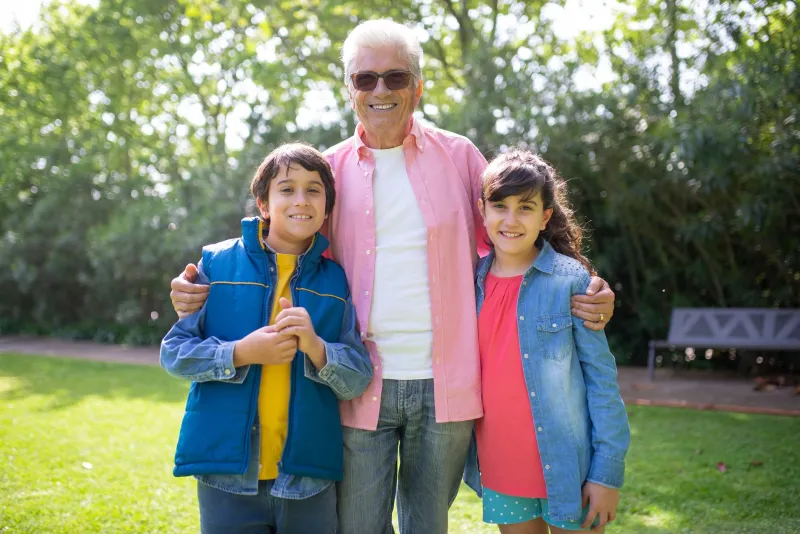
American families who've made the trip with multiple generations — grandparents, parents, kids, sometimes all three at once — describe the mountain in terms that sound almost too tidy to be true. Common ground. Shared language. The thing everyone agreed on. It's worth asking why.
What Each Generation Actually Sees
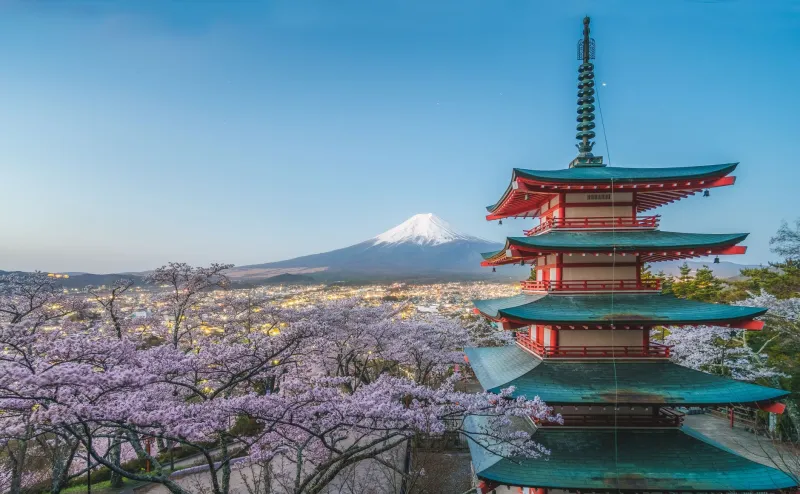
Stand at the viewing platform near Chureito Pagoda during peak bloom and watch a multigenerational family for a few minutes. You'll notice something interesting: they're all looking at the same thing, but they're not seeing the same thing.
Kids, especially younger ones, tend to respond to the sensory immediacy of it all. The petals falling like slow pink snow. The sheer number of stairs they just climbed. The way Mount Fuji fills the sky in a way that doesn't look real. Children haven't yet built the mental category of "postcard view" — to them, this is just the most extraordinary thing they've seen, and they respond accordingly, with noise and movement and demands to know if the petals taste like anything.
Parents, typically somewhere in their thirties or forties, often respond with a more complicated emotion. There's beauty in it, yes, but there's also the awareness that they're standing in front of something they'll tell their kids about for years, and that their kids are standing next to them right now, and that this specific moment is happening and will not happen again in exactly this configuration. That particular flavor of happiness and grief arriving at the same time is a very parental experience.
Grandparents bring something different still. Older visitors at Arakurayama frequently describe the cherry blossoms in terms of memory — not just personal memory, but something longer. The Japanese concept of mono no aware, the bittersweet awareness of impermanence, resonates differently when you've lived long enough to have watched many springs come and go. The blossoms aren't just beautiful. They're true. And standing next to a grandchild who's seeing this for the first time, while you're aware it may be one of your last times — that's a feeling that doesn't need translation.
The Steps: A Surprisingly Honest Equalizer
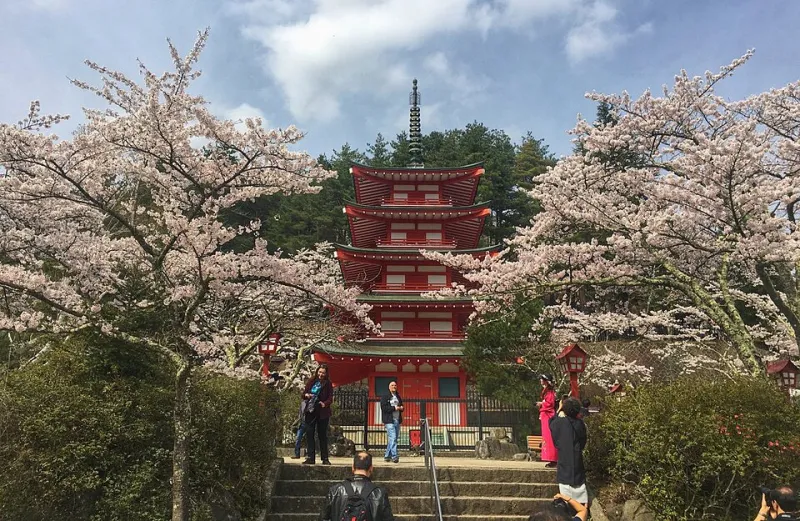
Let's talk about the 400 steps up to Chureito Pagoda, because they matter more than they might seem.
For young kids, the steps are a physical adventure — something to count, to race up, to complain about and then feel proud of conquering. For grandparents, they're a genuine physical challenge, and one that families need to plan for honestly. The climb is steep in sections, and there's no shame in taking it slow, resting on the stone lantern-lined path, or deciding that the lower viewing areas offer their own excellent vantage points.
What the steps do, practically and symbolically, is create a shared physical narrative. Everyone in the family did something to get to that view. The effort is proportional to the person — enormous for a five-year-old, significant for a seventy-eight-year-old, somewhere in between for everyone else — but everyone arrives having done something. That shared effort, small as it is, binds the experience in a way that simply buying a ticket to a scenic overlook doesn't.
Families who've done it report that the climb becomes part of the story. "Remember when Grandpa stopped to rest by the third lantern?" "Remember when she refused to be carried and did every single step herself?" The mountain gives the family something to narrate together, which is the quiet engine of intergenerational memory-making.
The Unexpected Gift of No Wi-Fi Pressure
Here's a generational tension that Arakurayama defuses without trying: the phone.
In most American family travel contexts, screens are a source of low-grade conflict. Teenagers are somewhere else mentally. Grandparents feel invisible. Parents are caught in the middle, half-managing the experience and half-documenting it. The usual rhythms of family togetherness get interrupted by notification sounds and the particular vacancy that comes over a face staring at a small screen.
At Arakurayama during peak bloom, something different happens. Everyone wants to take photos — yes, including the teenagers — but the view is so genuinely overwhelming that it commands actual attention. You look up. You look again. You try to find an angle that does it justice and discover you can't, which leads you to just... look. With your eyes. At the real thing.
Families describe an unusual quality of shared presence at the pagoda. Conversations that wouldn't happen at a dinner table happen here. A grandmother talks about what Japan meant to her generation. A teenager asks a question they'd never think to ask at home. A child reaches for a hand without being asked to.
The mountain doesn't manufacture these moments. It just removes enough of the usual noise that they can happen on their own.
What Families Take Home
The most durable outcome of a multigenerational Arakurayama trip isn't the photos, though the photos are good. It's the reference point.
Families who've made this trip together describe it as a shared landmark — something everyone in the family can point to as a moment when they were genuinely together, in the same direction, experiencing the same thing. In a family culture where different age groups often live in parallel rather than overlapping worlds, that kind of shared reference is quietly valuable.
"We all saw it" means something. It means you were there at the same time, in the same cold spring air, watching the same petals fall past the same pagoda with the same mountain behind it. That's not nothing. In a family, over time, that's actually quite a lot.
Arakurayama doesn't fix complicated family dynamics or paper over old tensions. But it does offer something most vacation destinations don't: a view so undeniably extraordinary that everyone in the family, regardless of age, forgets for a moment to be anything other than amazed.