Going It Alone: What Solo Travel to Arakurayama Actually Feels Like
The first thing people ask when you tell them you went to Japan alone is whether you were lonely. It's a fair question. Flying fourteen hours to stand on a mountain in a foreign country, surrounded by blooming cherry trees and thousands of strangers — that does sound like the setup for a particular kind of melancholy.
But ask anyone who's done it, and most will tell you something surprising: solo at Arakurayama isn't lonely. It's something else entirely. Something harder to name but easier to remember.
Why More Americans Are Making the Solo Trip
Solo travel in general has been climbing in popularity among Americans for years, but Arakurayama has become a specific draw for people traveling alone. Part of this is practical — Japan consistently ranks among the safest and most navigable countries in the world for solo foreign visitors. Public transit is reliable, signage is often bilingual, and the cultural norm of respecting personal space means solo travelers rarely feel conspicuous or pressured.
But there's something more specific pulling solo travelers to Arakurayama in particular. The mountain has a reputation — passed along in travel forums, blog comments, and hushed post-trip conversations — as a place that rewards solitude in a way that group travel simply can't replicate. You hear this enough times and eventually you want to find out for yourself.
The Logistics of Getting There Alone
Let's start with the practical, because the practical matters. Getting to Arakurayama from Tokyo as a solo traveler is genuinely manageable, even if you've never navigated Japan's train system before.
The most straightforward route runs from Shinjuku Station on the Chuo Line to Otsuki, then transfers to the Fujikyu Railway toward Fujiyoshida. From there, it's a short walk or local bus to the base of Arakurayama Sengen Park. The whole trip runs roughly two hours from central Tokyo, which means you can leave early, catch morning light on the pagoda, and be back in the city before dinner.
Traveling alone actually has a logistical advantage here: you move at your own pace. You don't wait for anyone. If you want to catch the 5:30 a.m. light at Chureito Pagoda, you catch it. If you want to sit on the steps for forty-five minutes doing nothing in particular, you do that too. There's no negotiating, no compromise, no checking in with someone who's cold and ready to leave.
For accommodation, Fujiyoshida has a range of options from budget guesthouses to small hotels. Solo travelers often find that guesthouses — especially those with shared common areas — offer an unexpected social bonus: brief, low-stakes conversations with other travelers from around the world who are also there for the bloom.
The Climb and What It Does to You
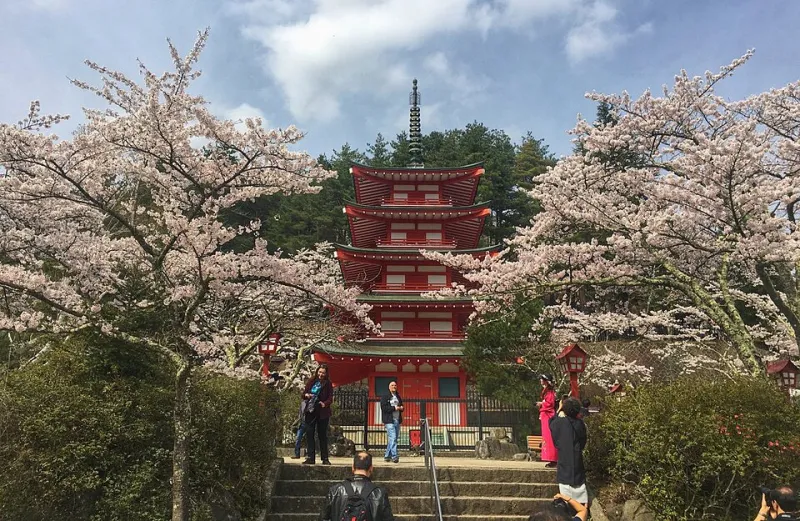
The hike up to Chureito Pagoda involves roughly 400 steps. It's not technically demanding, but it's not nothing either, especially if you're carrying a camera bag and started the day at 4:30 a.m. When you're with a group, the climb becomes a shared physical experience — people joke about the steps, check on each other, mark progress together.
Alone, it's different. The climb is just you and your breathing and the sound of your footsteps. You notice more. The way the light filters through the trees before sunrise. The other early risers passing you in silence, everyone tacitly agreeing not to break the spell. The moment the pagoda comes into view and your chest does something involuntary.
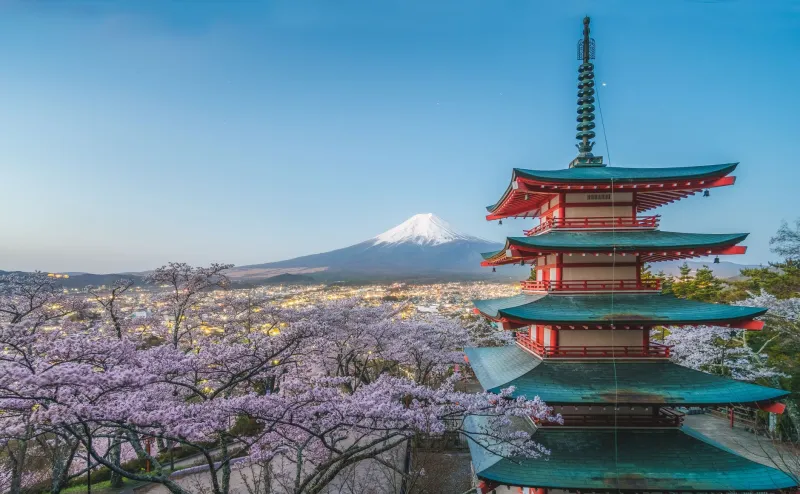
Solo travelers consistently describe this moment — the first full view of the pagoda with Mount Fuji behind it — as more emotionally intense than they expected. Some cry. Some just stop walking and stand very still. Without a companion to share the reaction with, the feeling turns inward, and it tends to go deeper.
There's a vulnerability in that. You can't deflect the emotion by turning to someone and saying "wow, right?" You just have to feel it, which turns out to be the whole point.
The Particular Texture of Solitude Here
Solitude at Arakurayama is not the same as solitude on a solo trip to, say, a European city. In a city, being alone can tip into isolation — you're surrounded by people who are all engaged with each other, and the contrast can sting. At Arakurayama, especially during peak bloom, solitude feels different because the mountain itself is the companion.
The Japanese concept of ma — the meaningful pause, the productive empty space — feels physically present here. The view asks nothing of you. It doesn't need you to perform enjoyment or articulate why it's beautiful. You can simply be in front of it, which is a surprisingly rare permission in modern life.
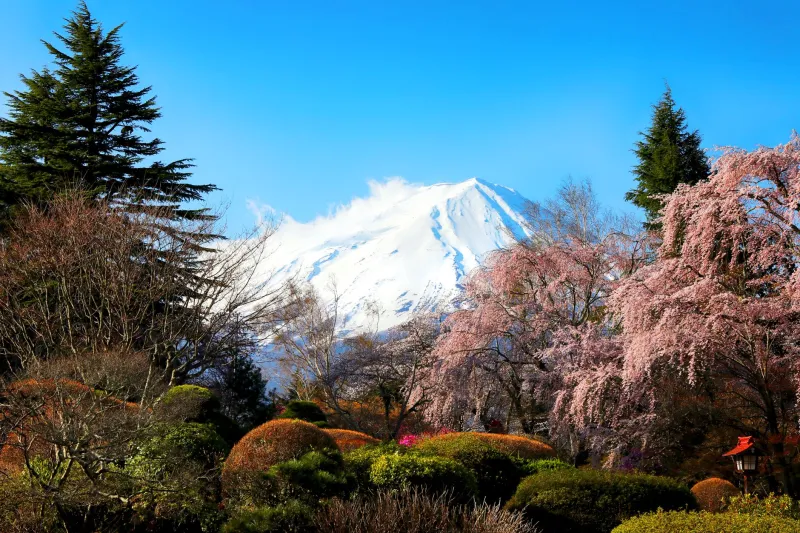
Solo travelers often describe a quality of attention they couldn't sustain in a group. Without conversation filling the space, you notice the specific pink of a particular cluster of blossoms. You track the shadow of a cloud crossing the face of Fuji. You observe how the crowd thins and swells in waves throughout the morning. You become, without really trying to, more present than usual.
What You Bring Home That You Didn't Bring With You
The thing solo Arakurayama travelers talk about most — when they talk about it at all, because many hold it close — is a recalibrated sense of their own company. Spending a day on that mountain alone, with a view that big and a silence that deliberate, has a way of clarifying things.
Some people work out decisions they'd been avoiding. Some people just feel, for the first time in months, genuinely unhurried. Some people discover they like themselves more than they'd been giving themselves credit for.
None of this is guaranteed, and none of it requires any particular spiritual framework. It's simpler than that. You went somewhere beautiful, alone, and you were okay. More than okay, actually.
That's worth a fourteen-hour flight.