Spend More, Regret Less: The Unusual Economics of an Arakurayama Pilgrimage
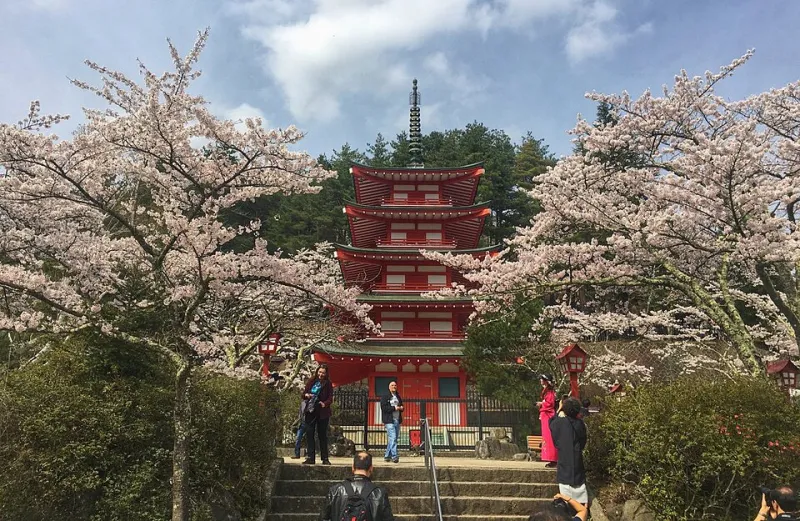
Photo: Manish Prabhune, CC BY-SA 4.0, via Wikimedia Commons
Let's do the math nobody wants to do out loud. A round-trip flight from the US to Japan: anywhere from $900 to $1,800 depending on your departure city and how far in advance you planned. Add three to five nights in a ryokan or hotel near Fujiyoshida, meals, transportation, and the inevitable ceramics or furoshiki you'll buy at a roadside shop, and you're looking at a trip that clears $3,000 without breaking a sweat. For peak bloom season, tack on a premium for everything.
Now compare that to, say, a long weekend in Napa. A beach house in the Outer Banks. A ski trip to Park City. All of those feel justifiable — they're domestic, familiar, and easy to explain at a dinner party. But flying to Japan to watch cherry blossoms fall on a mountainside? That takes a different kind of convincing.
And yet Americans are doing it in growing numbers, often returning year after year, and almost universally reporting that it was worth every cent. So what's actually going on here?
Why Conventional Travel ROI Doesn't Apply
Most Americans evaluate vacations through a pretty standard lens: cost per day, comfort level, Instagram yield, and how rested they feel on Monday morning. By those metrics, Arakurayama should be a tough sell. The hike up to Chureito Pagoda is steep. The crowds during peak bloom are real. There's no beach, no all-inclusive buffet, no swim-up bar.
But visitors consistently describe the experience in language that doesn't show up in resort reviews. Words like perspective, reset, clarity, and — this one comes up a lot — irreplaceable. That last word is the key to understanding why the budget math stops mattering.
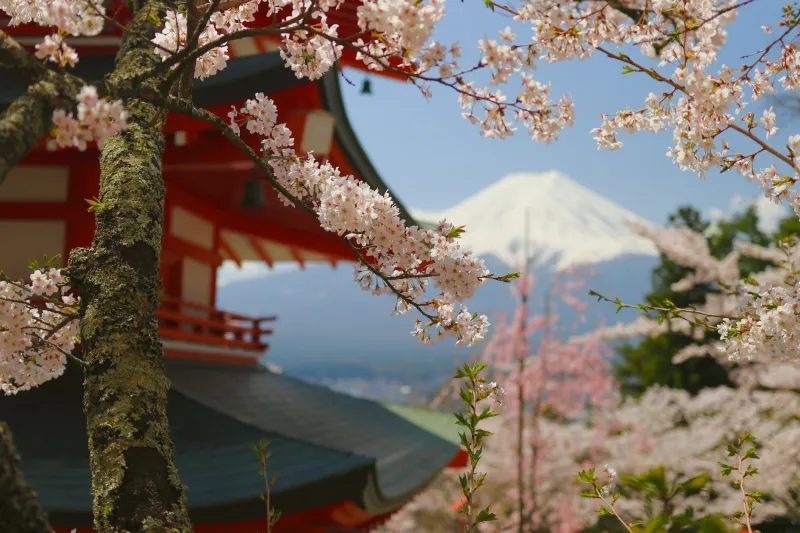
Psychologists who study experiential spending have found that people derive more lasting satisfaction from experiences that feel singular — ones that can't be easily replicated or substituted. A luxury hotel room is nice, but it's also interchangeable. Arakurayama at peak bloom, with Mount Fuji behind the pagoda and petals in the air, is not interchangeable with anything. That uniqueness is precisely what justifies the cost in the minds of people who go.
The Pilgrimage Premium
There's a concept in behavioral economics called the "effort heuristic" — the idea that we value things more when we've worked harder to get them. Arakurayama activates this on multiple levels. You've crossed an ocean. You've navigated a foreign transit system. You've climbed 398 steps up to a pagoda while slightly jet-lagged. By the time you're standing at the viewpoint with cherry blossoms in your peripheral vision and Fuji in the distance, your brain has already decided this was worth it before you've consciously processed the scene.
This is the pilgrimage premium. It's not unique to Japan — you see it at Machu Picchu, at the Amalfi Coast, at Patagonia. But Arakurayama delivers it with unusual consistency, partly because the bloom itself is time-limited. You can't just come back next month if the timing is off. The scarcity sharpens everything.
Comparing Emotional ROI
Here's a question worth sitting with: when was the last time you came back from a vacation and felt genuinely changed by it? Not just rested, but actually different in some small, lasting way?
Visitors to Arakurayama report this at a rate that's hard to explain away. Forum threads, travel blogs, and Reddit posts are full of Americans describing a before-and-after quality to the trip — a recalibration of what they find beautiful, what they find worth rushing toward, and what they're willing to let go of. That's not typical vacation language. That's the language of transformation.
From a purely financial standpoint, you can't put a number on that. But you can compare it to what Americans spend on therapy, on wellness retreats, on self-help books and meditation apps — all of which are also in the business of changing how you relate to your own life. Arakurayama competes in that market whether it intends to or not, and it tends to win.
The Return Trip Problem
Here's where the economics get really interesting: the repeat visitor rate. A striking number of Americans who make the Arakurayama trip once end up going back. Sometimes within two years. Sometimes every single spring.
From a purely rational standpoint, this makes no sense. You've seen the pagoda. You've had the moment. Why spend $3,000-plus again?
Because the experience isn't a destination you check off — it's a relationship you maintain. The mountain changes with the seasons and with you. The bloom is never exactly the same twice. And the person standing at the top of those 398 steps is never exactly the same either. That's a fundamentally different value proposition than any resort can offer, and Americans are figuring that out one repeat booking at a time.
What the Splurge Is Actually Buying
If you strip away the flights, the hotels, the logistics, and the souvenir spending, what you're really paying for at Arakurayama is a specific kind of attention. The kind that only kicks in when you've made a significant investment to be somewhere, when the window is narrow, and when the scene in front of you is genuinely unlike anything in your normal life.
That quality of attention — full, unhurried, and unmediated by routine — is increasingly rare in American life. And rare things, as any economist will tell you, command a premium. Arakurayama just happens to be one of the few places on earth that reliably delivers it.
So does the trip break the budget? Probably. Does it break the travel budget rules that say you should spend your money on comfort and convenience and predictable returns? Absolutely. Does any of that stop Americans from booking the flight anyway?
Not even a little.