Why Arakurayama Travels Home With You: The Word-of-Mouth Phenomenon Nobody Planned
You've heard it before. A coworker comes back from Japan, sits down at their desk, and within forty-eight hours has shown you approximately eleven hundred photos of a mountain covered in pink blossoms. They're not bragging exactly. It's more urgent than that. They need you to understand something, and they're not entirely sure how to explain what that something is.
Welcome to what regulars have started calling the Arakurayama Effect — the strange, socially contagious aftermath of seeing peak bloom at Arakurayama Sengen Shrine in Fujiyoshida. It's one of the most reliably reproducible behaviors in modern travel culture, and it raises a genuinely interesting question: why does this particular mountain turn ordinary vacationers into tireless, unpaid evangelists?
It's Not Just a Pretty View
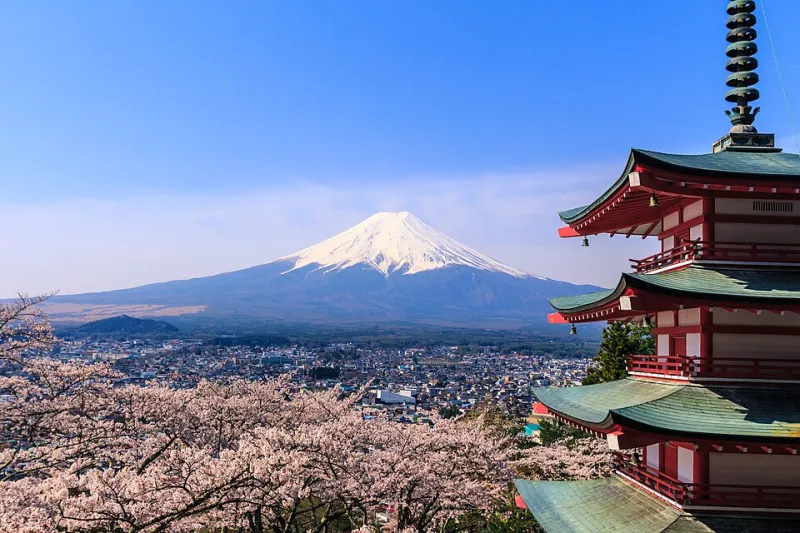
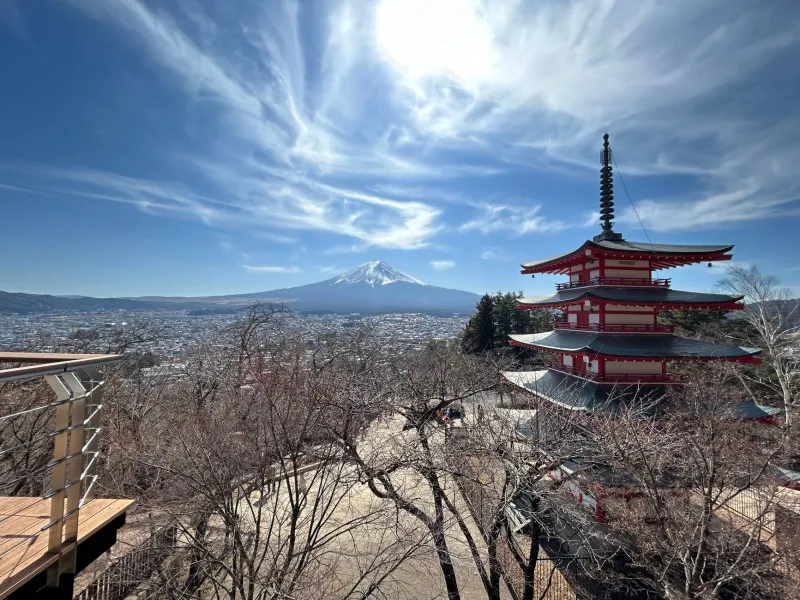
Let's get the obvious out of the way. Yes, the view is extraordinary. The five-storied Chureito Pagoda framed against Mount Fuji with a blizzard of cherry blossoms in the foreground is, by most aesthetic measures, one of the most compositionally perfect scenes on the planet. But gorgeous views don't automatically produce this level of social contagion. People see beautiful things all the time and keep it largely to themselves.
What Arakurayama does differently is deliver a kind of sensory overload that the brain genuinely struggles to file away as a normal memory. Researchers who study awe — that specific emotion triggered by encounters with vastness or beauty beyond your frame of reference — have found that awe experiences are disproportionately likely to be shared socially. They disrupt your sense of self in a small but meaningful way, and humans instinctively reach for other people when their inner world gets shaken up.
Peak bloom at Arakurayama is almost engineered to produce awe. The scale of Mount Fuji behind you, the delicacy of the blossoms in front of you, the pagoda anchoring it all — it's a scene that refuses to fit neatly into the mental category of "nice vacation spot." Your brain knows it witnessed something, and it wants witnesses of its own.
The Rarity Factor Does Real Psychological Work
There's another layer to this. Arakurayama's peak bloom window is famously narrow — typically somewhere between late March and mid-April, with the sweet spot often lasting less than two weeks. The exact timing shifts year to year based on temperature patterns, which means no visitor can be fully certain they've timed it right until they're standing there.
Psychologists call this kind of limited availability a scarcity cue, and it dramatically inflates perceived value. When you catch peak bloom at Arakurayama, you didn't just go to Japan — you won a small, unrepeatable lottery. That sense of having been in exactly the right place at exactly the right moment is incredibly shareable, because it comes with a built-in narrative tension. You almost missed it. The weather almost didn't cooperate. But it worked out, and here you are, standing in front of something that millions of people will never see in person.
That story practically tells itself at dinner parties.
The Photo Problem (And Why It Actually Helps)
Here's a quirk worth noting: Arakurayama produces some of the most widely circulated travel photography on the internet, yet visitors consistently report that no photo adequately captures being there. This creates a peculiar social dynamic. You show people your pictures, they're impressed, and then you spend the next ten minutes explaining why the pictures don't do it justice.
That gap — between what the image conveys and what the experience actually felt like — is conversational gold. It gives you something to say beyond "it was beautiful." It forces a kind of storytelling that's richer and more personal than a photo dump. You end up describing the cold air, the sound of the crowd thinning out at dawn, the way the light hit the pagoda at a specific angle for about four minutes. You become a narrator, not just a photographer.
And narrators, as it turns out, are memorable. Friends and family who hear a good Arakurayama story tend to remember it — and tend to bring it up again months later when Japan comes up in conversation.
The Community You Didn't Know You Were Joining
There's a social identity component here too. Visitors who've made the trip to Arakurayama during peak bloom often describe a quiet but real sense of belonging to a group — a loose, international community of people who've seen the same thing and carry the same slightly-stunned expression in their memory.
This isn't manufactured by tourism marketing. It emerges organically from shared experience. When you meet another American who's also done the climb to Chureito Pagoda in bloom season, there's an immediate shorthand. You know what the steps feel like at 5 a.m. You know the specific quality of that light. You're in the club.
Social identity theory suggests that people actively promote experiences that define groups they want to belong to. Talking about Arakurayama isn't just reminiscing — it's signaling membership in a particular kind of traveler community. One that values effort, timing, beauty, and the willingness to do something genuinely inconvenient in pursuit of something genuinely extraordinary.
What This Means for Anyone Who Hasn't Gone Yet
If you've been on the receiving end of an Arakurayama evangelist — nodding politely while your coworker describes the pagoda for the third time — you might find it reassuring to know there's real science behind their behavior. They're not showing off. They're processing.
And if you're on the fence about making the trip yourself, consider this: the people most likely to talk your ear off about Arakurayama are also the people least likely to tell you it wasn't worth it. In a travel culture full of overhyped destinations that disappoint on arrival, that's a data point worth sitting with.
The mountain has a way of making believers out of skeptics. And believers, as anyone who's sat next to one on a flight home can confirm, are very hard to quiet down.