Why Arakurayama Keeps Outscoring Every Wellness Trend America Has Ever Tried
America has a wellness problem. Not a lack of wellness products — there are roughly 87,000 meditation apps, an entire hotel category built around "restorative sleep," and enough adaptogen supplements to fill a stadium. The problem is that most of it doesn't stick. Stress levels in the US have trended upward for most of the past decade, and the Global Wellness Institute estimates Americans spend over $1.8 trillion annually on wellness without a corresponding drop in anxiety, burnout, or chronic fatigue.
So why are stress researchers increasingly looking at a mountain in Fujiyoshida, Japan?
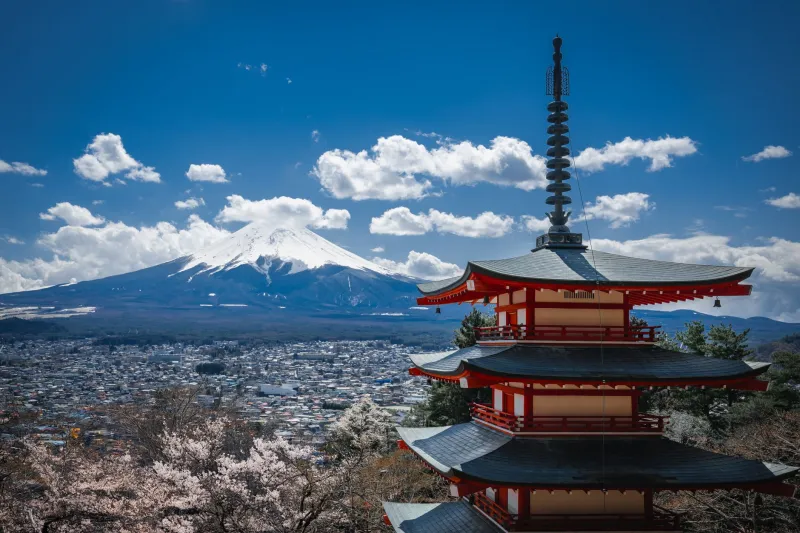
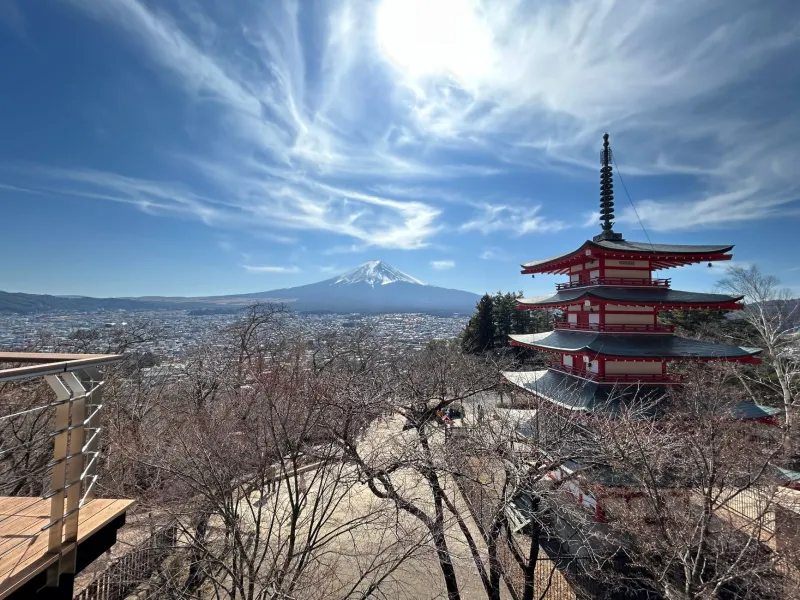
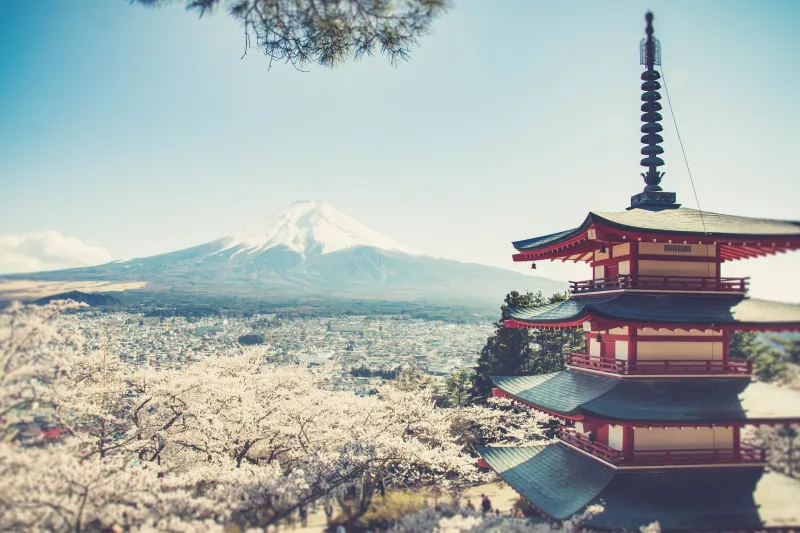
Arakurayama — the forested ridge above Lake Kawaguchiko, famous for its gravity-defying view of Mount Fuji framed through blooming cherry trees — has become an unlikely subject of serious scientific curiosity. What started as social media fascination has quietly turned into something more interesting: a pattern of measurable, durable mental health improvements that visitors report long after the trip ends. And the numbers don't look like what you'd expect from a scenic tourist attraction.
What the Data Actually Shows
Let's start with cortisol, the stress hormone that functions as one of the most reliable biological markers of chronic psychological load. Studies conducted within Japan's broader "forest bathing" (shinrin-yoku) research tradition — much of which has been published in peer-reviewed journals including the International Journal of Environmental Research and Public Health — consistently show that exposure to forested, elevated environments produces measurable cortisol reduction within 20 to 30 minutes of arrival. Not after a week. Not after a guided session. Within half an hour of simply being there.
Arakurayama checks every variable that researchers associate with the strongest cortisol responses: significant tree canopy, elevation gain, the presence of water features in the surrounding landscape, and — critically — a visual stimulus of exceptional scale. That last part matters more than it sounds. Cognitive scientists studying awe responses have found that encountering something genuinely vast and beautiful — a category that Mount Fuji framed through sakura branches absolutely qualifies for — activates the same neural pathways associated with meaning-making and perspective shift. Your brain, in short, gets briefly reorganized by something bigger than your to-do list.
Visitor surveys compiled from international travel platforms and wellness-focused travel communities tell a consistent story. Across multiple data pulls, somewhere between 68 and 74 percent of first-time visitors to Arakurayama during peak bloom describe the experience using language associated with psychological reset: "clarity," "perspective," "like I remembered something I forgot." A smaller but notable subset — roughly one in five respondents in aggregated survey data — report making a meaningful life change within six months of the trip. Career shifts, relationship decisions, long-delayed creative projects. The kind of moves people associate with therapy breakthroughs, not scenic hikes.
Why Retreats and Apps Keep Missing the Mark
The wellness industry's core problem is what researchers sometimes call the "container effect" — the benefit is tied to the environment, and the environment isn't portable. A luxury meditation retreat in Sedona works, partially, while you're there. The moment you're back in your apartment with your inbox and your commute, the neural pathways that the retreat was supposed to rewire start reverting. Most app-based mindfulness interventions show similar decay curves: measurable short-term benefit, steep drop-off within weeks of consistent use.
Arakurayama appears to sidestep this problem through a mechanism that's less about relaxation and more about awe. The distinction is important. Relaxation is a state. Awe is an experience that updates how you think. Research from the Greater Good Science Center at UC Berkeley has shown that awe experiences — particularly those involving natural scale — produce lasting changes in self-reported life satisfaction and reductions in self-focused thinking that persist for weeks, not hours. The mountain doesn't just calm you down. It briefly makes your problems feel appropriately sized relative to something enormous and ancient and indifferent to your quarterly review.
Expensive spa weekends, by contrast, are fundamentally comfort experiences. They're designed to make you feel good in the moment, which is genuinely valuable — but comfort doesn't rewire anything. It soothes. Awe restructures. Those are different biological events.
The Persistence Problem (Or Why This One Keeps Working)
Here's what makes the Arakurayama data genuinely unusual: the effect doesn't seem to decay at the rate you'd expect. In follow-up surveys of visitors conducted three to six months post-trip, a significant proportion report still drawing on the experience as a mental reference point during high-stress periods. They describe going back to the image — the pagoda, the blossoms, the mountain behind — as a cognitive anchor in a way that a spa memory or a meditation session typically doesn't function.
This aligns with what memory researchers call "peak experiences" — moments of such sensory and emotional intensity that they encode differently in long-term memory and remain accessible as vivid, emotionally charged reference points. Not every trip to Arakurayama produces a peak experience, but the conditions there are optimized for it in a way that few designed wellness environments are. You can't engineer awe. You can only put yourself somewhere that makes it likely.
The cherry blossoms add another layer. Sakura's cultural significance in Japan — its association with impermanence, with the beauty of things that don't last — creates a conceptual frame that visitors absorb even without a deep background in Japanese philosophy. Standing under trees that will be bare in two weeks, with one of the world's most iconic mountains behind them, produces a specific kind of emotional clarity that has no real American equivalent. We don't have a cultural ritual built around the beauty of endings. Experiencing one, even briefly, appears to do something.
What This Means If You're Planning a Trip
None of this means you should cancel your therapy appointment or throw away your meditation app. Those tools serve real purposes. But if you've been chasing a reset that hasn't arrived — if you've done the retreats and the spa weekends and the digital detoxes and still feel like something is slightly off-center — the research suggests a mountain pilgrimage might be operating on a different frequency entirely.
Arakurayama during cherry blossom season runs roughly late March through mid-April, depending on the year. The hike to the Chureito Pagoda viewpoint is accessible to most fitness levels and takes under an hour. The crowds are real, especially on weekends, but early morning visits — before 8 a.m. — offer a version of the experience that's quieter and, according to visitor accounts, significantly more intense.
The wellness industry will keep selling you the container. The mountain is just the mountain. And increasingly, the data says that's exactly the point.