Jet Lag Shouldn't Feel Like This: What Arakurayama Is Doing to Visitors' Body Clocks
Anyone who's flown from the East Coast to Tokyo knows the drill. You land feeling vaguely human, spend three days cycling between exhaustion and insomnia, and finally start feeling normal around the time your return flight is boarding. It's a rite of passage for Japan travelers, as expected as the vending machines and the impeccable train schedules.
So when visitors to Arakurayama started saying things like "I felt totally fine by day two" and "I actually slept through the whole first night," it raised some eyebrows. Was it placebo? Selective memory? Or is something genuinely different about spending your Japan trip on a mountain chasing cherry blossoms?
Turns out, there might be more to it than luck.
The Jet Lag Problem, Briefly Explained
Your circadian rhythm — the internal clock that tells your body when to sleep, eat, and be alert — runs on light cues. Specifically, it's calibrated by the timing of sunlight hitting your eyes each morning. When you cross multiple time zones, that calibration gets thrown off. Japan sits roughly 13 to 14 hours ahead of US Central time, which means your body is essentially trying to sleep at noon and stay awake at midnight.
Recovery typically takes one day per time zone crossed, though that varies by person, direction of travel, and how well you manage light exposure on the plane and in the days after landing. Most travelers budget at least three to four rough days before they feel sharp again.
So what's different about Arakurayama?
Morning Light at Elevation Does Something
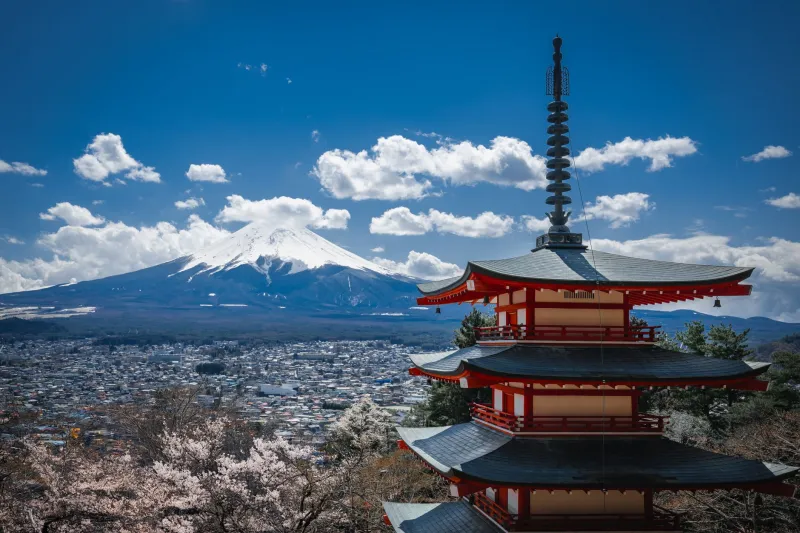
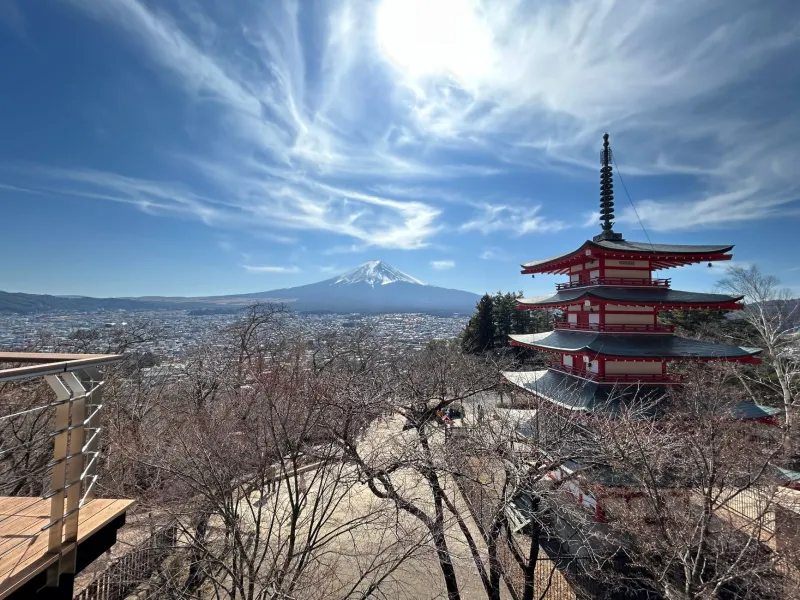
Arakurayama sits at roughly 832 meters above sea level on the outskirts of Fujiyoshida City in Yamanashi Prefecture. The mountain faces east, which means early risers get hit with direct morning sunlight almost immediately after dawn — and that sunrise comes with a particular quality at altitude. Less atmospheric filtering, more intensity, earlier and more sustained exposure.
Sleep researchers have known for years that bright morning light is one of the most powerful tools for resetting a disrupted circadian rhythm. The mechanism involves suppressing melatonin production and shifting the phase of your internal clock forward. In plain terms: getting outside early and soaking up sunlight tells your body to start treating this morning as morning.
At Arakurayama, that's almost impossible to avoid. The trails open early. The crowds thin out by mid-morning, which nudges visitors to arrive at dawn. The mountain's orientation means the light is right in your face from the moment you start climbing. If you designed a jet lag recovery protocol from scratch, it would look a lot like a morning hike up Arakurayama.
The Altitude Factor
There's also a quieter physiological argument around altitude and oxygen levels. At elevation, your body works slightly harder to deliver oxygen to tissues, which can gently increase alertness and elevate baseline metabolic activity. Some researchers have suggested that mild hypoxic conditions — the kind you'd experience at a few hundred meters above sea level — can influence sleep architecture, sometimes improving slow-wave sleep quality in people who are already sleep-deprived.
This isn't the dramatic altitude effect you'd get at 10,000 feet. But it may contribute to why visitors report sleeping more soundly after a day on the mountain than they expected to.
Pacing That Actually Works in Your Favor
Here's where the sakura season itself becomes part of the equation. Cherry blossom trips aren't built for frantic sightseeing. You're not racing between 14 temples in a day. Arakurayama during peak bloom is a slow experience — you climb, you stop, you look, you sit, you climb again. Meals happen at reasonable hours. There's a natural rhythm to the day that mirrors what circadian researchers call "zeitgebers" — external time cues that help anchor your internal clock.
Regular mealtimes, consistent physical activity, and defined start and end points to the day are all things that help your body recalibrate after a long-haul flight. A structured mountain visit, almost accidentally, delivers all three.
Kara Simmons, a nurse from Portland who made her second trip to Arakurayama last spring, put it this way: "I've done Tokyo before. I've done Kyoto. Both times I was wrecked for days. This time I was hiking by 7am on day two and felt totally present. I honestly don't know if it was the mountain or the fact that I wasn't running around trying to see everything at once."
That tension — between frantic tourism and deliberate, place-rooted travel — might be exactly the point.
What Returning Visitors Are Actually Saying
We heard variations of the same story from multiple repeat visitors. Marcus T., a software engineer from Austin who has made the Arakurayama trip three springs in a row, noted that he now deliberately schedules his arrival for the day before he plans to hike. "I land, I sleep as long as I can, I eat a real meal, and the next morning I'm up at first light on the mountain. By day three I feel like I never left home. It sounds weird but the mountain kind of pulls you into its schedule."
That phrase — the mountain pulls you into its schedule — came up more than once. There's something about a destination with its own clear temporal logic (bloom here, light there, crowds at this hour, quiet at that one) that gives travelers an external structure to latch onto, which may be doing a lot of the heavy lifting that would otherwise fall to melatonin supplements and blackout curtains.
Practical Takeaways for Your Trip
If you want to use Arakurayama's natural rhythms to work through jet lag faster, a few things are worth planning around:
Get outside early on day one. Even if you're exhausted, try to catch morning light on the mountain or in the area around Fujiyoshida. An hour of direct sunlight before 9am is one of the most evidence-backed jet lag interventions available.
Eat on local time from the start. Don't wait until you're hungry by your home-time clock. Align your meals with Japanese meal times immediately. The local food culture makes this easier than it sounds — breakfast sets at the ryokans around the mountain are early and worth waking up for.
Hike at a pace that matches your energy, not your itinerary. Arakurayama isn't a race. If you're dragging, slow down. The physical movement still helps, even at a gentle pace.
Resist the urge to nap past early afternoon. If you must nap, keep it under 30 minutes and do it before 2pm local time. Then get back outside.
Something About This Place
None of this is magic, exactly. The physiology is real and reasonably well understood. But there's also something harder to quantify happening at Arakurayama — a quality of attention the mountain demands that pulls you out of your own head and into the present moment. The cherry blossoms are only here for a week or two. The light on the pagoda at dawn only lasts a few minutes. You can't half-pay-attention and still get what you came for.
That kind of presence, it turns out, might be exactly what a confused, jet-lagged brain needs to find its footing in a new time zone.
The mountain doesn't care what time it is back home. And somehow, after a day or two on the trails, neither do you.