One Mountain, Whole New Mindset: How Arakurayama Rewired the Way Americans Experience Nature
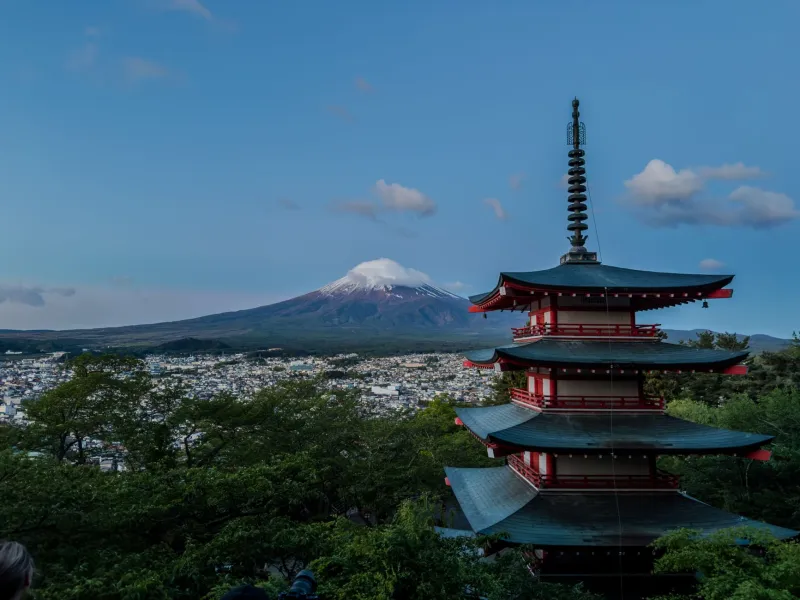
There's a moment that a lot of American visitors to Arakurayama describe in almost identical terms. You've climbed the stone steps. You're breathing harder than you expected. And then the tree line opens up, Mount Fuji materializes through a curtain of pink blossoms, and something inside you just — stops. Not in a bad way. In the way that a long-running mental monologue finally hits pause.
People come here for the photos. They leave having had something closer to a reckoning.
Arakurayama isn't the most famous cherry blossom destination in Japan. Kyoto's Maruyama Park gets more press. Tokyo's Shinjuku Gyoen pulls bigger crowds. But there's a reason travel writers, wellness bloggers, and ordinary tourists keep circling back to this mountain outside Fujiyoshida with a reverence that's hard to fake. Something about this specific place — its elevation, its framing, its particular combination of effort and reward — seems to crack people open in a way that a flat city park simply doesn't.
The Effort Factor Changes Everything
Let's start with the obvious: you have to work a little to get here. Whether you're climbing the 397 stone steps to Chureito Pagoda or taking one of the longer ridge trails, Arakurayama asks something of your body before it gives you the view. And that physical investment, small as it is by hiking standards, turns out to matter enormously.
Sports psychologists and outdoor recreation researchers have a term for this: effort justification. Basically, the harder we work for something, the more meaningful we perceive it to be. But there's more going on at Arakurayama than effort justification. The trail through the forested hillside — cedar and cypress pressing in close, light filtering in broken angles, the smell of damp soil and bark — is doing its own quiet work on your nervous system long before you reach the pagoda.
This is shinrin-yoku territory. Forest bathing, as the Japanese practice is loosely translated, isn't about exercise. It's about presence. It's the intentional act of moving slowly through trees and letting the sensory environment of the forest register in your body. Japan's Forestry Agency has been studying its physiological effects since the 1980s, and the data is consistent: reduced cortisol levels, lower blood pressure, measurable upticks in immune function. The forest isn't just a backdrop at Arakurayama. It's part of the experience itself.
Why This Mountain, Specifically
America has no shortage of stunning natural landscapes. We have the Rockies, Appalachian forests, the Pacific coast. So why does a mid-sized mountain in Yamanashi Prefecture keep showing up in the personal transformation stories of American travelers?
Part of it is the cultural container. In Japan, cherry blossom season — hanami — isn't just an aesthetic event. It's a philosophical one. The fleeting nature of the blooms is inseparable from the Japanese concept of mono no aware, the bittersweet awareness that beautiful things don't last. When Americans arrive at Arakurayama during peak bloom, they're stepping into a cultural tradition that has been intentionally building meaning around impermanence for centuries. That's a very different experience from, say, stumbling across a flowering tree in a city park.
There's also the verticality. Most famous hanami spots in Japan are flat. You spread a picnic blanket, you look at blossoms at eye level, you enjoy the party atmosphere. Arakurayama asks you to look up at the mountain, and then to look out from it. That shift in perspective — literally and figuratively — seems to do something to people's sense of scale. Standing above the cloud line with Fuji in your sightline has a way of making ordinary worries feel appropriately small.
Wellness Tourism Meets Genuine Ritual
It would be easy to dismiss this as wellness tourism dressing up a pretty hike. But the Americans who keep coming back to Arakurayama — and there are more of them every year — tend to push back on that framing pretty hard.
"I've done meditation retreats, I've done float tanks, I've done all of it," one solo traveler from Portland told me. "This was the first time nature actually felt like a practice instead of a backdrop."
That distinction matters. A backdrop is something you stand in front of. A practice is something you participate in. Arakurayama, at its best, functions as the latter — especially for visitors who come with some awareness of what the mountain and the season actually mean in Japanese culture.
The growing American interest in forest bathing, seasonal living, and what some wellness writers are calling "nature pilgrimage" has created a kind of readiness in the US travel market. People aren't just looking for beautiful destinations anymore. They're looking for destinations that mean something, that offer a frame for reflection that their daily lives don't easily provide. Arakurayama, with its ancient stone steps, its pagoda that has stood since the 9th century, and its blooms that arrive and vanish on their own schedule regardless of anyone's plans, fits that need almost perfectly.
The Ritual You Didn't Know You Were Looking For
Here's what strikes most American visitors about Japanese cherry blossom culture: it's intensely communal and intensely personal at the same time. People gather in groups, yes, but there's also a quality of individual contemplation built into hanami that doesn't really exist in Western seasonal celebrations. Nobody's trying to convince you to feel a certain way. The season just is what it is, and you bring yourself to it.
For Americans accustomed to experiences that are designed, optimized, and delivered — even our national parks have visitor experience managers — that quality of unmediated encounter can feel almost startling. The cherry trees at Arakurayama don't care about your itinerary. They bloom when the temperature and daylight tell them to. They drop their petals in the wind. You showed up or you didn't.
That's not indifference. In the context of Japanese seasonal philosophy, it's actually an invitation — to sync up with something larger than your schedule, to accept that the best experiences aren't the ones you control.
Coming Home Different
The Arakurayama effect, as some travelers have taken to calling it, tends to show up a few weeks after you're back in the States. You notice the cherry trees in your neighborhood for the first time. You slow down on a walk through a park. You find yourself paying attention to what's blooming and what's fading in a way that didn't used to register.
That's not magic. That's what happens when you've had a genuine experience of seasonal awareness somewhere that takes it seriously. Arakurayama doesn't give you a new philosophy. It gives you a felt sense of one that you can carry back with you.
And honestly? That might be worth more than the photo.