Slower by Design: How Arakurayama Quietly Rewires the American Relationship with Time
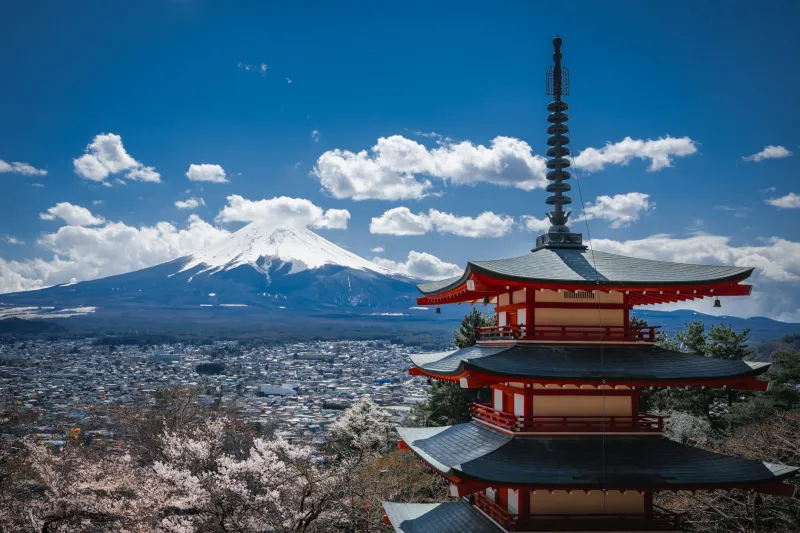
Somewhere between the 398 stone steps and the moment the pagoda finally appears above a sea of pink, something shifts. It's hard to name it in real time. You're breathing harder than expected, your phone is already out, and the crowd around you is moving at a pace that feels almost deliberately unhurried. But later — back home, sitting in traffic or refreshing your inbox at 11 p.m. — you'll remember that feeling. And you'll wonder why everything in your regular life feels so unnecessarily fast.
That's the Arakurayama effect. And it's more common than you'd think.
The Mountain Doesn't Care About Your Schedule
American travel culture tends to run on optimization. Itineraries are packed tight, layovers are calculated down to the minute, and the goal is usually to see as much as possible before the flight home. Arakurayama resists all of that — not aggressively, but completely.
The cherry blossoms bloom when they bloom. Peak sakura at Arakurayama's Chureito Pagoda typically falls in late March to mid-April, but the exact window shifts year to year based on temperature patterns, snowmelt from Mount Fuji, and conditions that no algorithm reliably predicts. You can consult the bloom forecasts, watch the tracker updates, and still arrive a few days early or a few days late. The mountain doesn't negotiate.
For visitors used to controlling outcomes, this is either maddening or quietly liberating. Most people who've made the trip will tell you it ends up being the latter — but only after a period of genuine frustration.
"I spent the first day annoyed," admitted Marcus, a project manager from Chicago who visited Arakurayama in April of last year. "I'd built this whole trip around hitting peak bloom, and the trees were maybe 70 percent open. I kept checking my phone like the forecast was going to change. Then at some point I just... stopped. And I realized the mountain was beautiful anyway. I'd been missing it because I was too busy being disappointed it wasn't perfect."
Why Winding Paths Do What Wellness Apps Can't
The trail up to Chureito Pagoda isn't long by hiking standards — but it's not a stroll either. The path winds, the steps are uneven in places, and the experience rewards attention. You can't really zone out and power through it. The terrain asks you to be present.
This is actually significant from a behavioral standpoint. Researchers who study what's sometimes called "restorative environments" have found that natural settings with moderate complexity — paths that turn, landscapes with layered depth, sounds that shift — tend to interrupt the kind of directed attention that leaves people mentally depleted. You can't multitask your way up a mountain. Your brain gets a break not because you're trying to rest, but because the environment demands something different from it.
Digital detox retreats try to manufacture this by removing devices. Arakurayama doesn't need to take your phone away. The mountain just becomes more interesting than whatever's on it.
"I took probably 200 photos," laughed Dana, a graphic designer from Portland who visited two springs ago. "But I also noticed things I never would have at home. The way the light hit the blossoms differently depending on the cloud cover. The sound of the wind. I wasn't detoxing from technology — I was just actually somewhere worth being."
The Habits People Bring Home
Here's where it gets interesting: the Arakurayama effect doesn't always stay in Japan. A surprising number of return visitors describe specific behavioral changes they've traced back to their time on the mountain — not dramatic life overhauls, but small, durable shifts in how they handle time.
Several people mentioned starting to build intentional pauses into their workdays. Not meditation sessions or structured breaks, just... stops. A few minutes to step outside. A walk without a destination. "I started taking a longer route to my office," said Priya, a marketing director from Austin. "Nothing scenic about it, honestly. But I remembered how the walk up to the pagoda felt, and I wanted some version of that in my regular life."
Others talked about becoming more comfortable with uncertainty around timing. One couple from Seattle described how they've stopped over-scheduling their weekends since returning. "We used to plan every hour," said one of them. "Now we leave gaps. It sounds small, but it genuinely changed how our weekends feel."
Marcus, the project manager from Chicago, said the shift showed up at work. "I stopped trying to predict exact outcomes on every project. You do your research, you prepare, and then you let things unfold a little. Arakurayama kind of taught me that. You can't force the bloom."
Timing as Practice, Not Logistics
One of the things that distinguishes an Arakurayama trip from a typical tourist checklist is that timing the visit is genuinely part of the experience. You're not just booking a flight and showing up — you're paying attention to natural cycles, making judgment calls with incomplete information, and accepting that you might not get it exactly right.
For Americans conditioned to expect precision — GPS that reroutes in real time, delivery windows measured in hours — this is unusual practice. And practice is the right word. The more you do it, the more comfortable you get with approximate rather than exact.
The bloom trackers that cover Arakurayama's cherry blossom season are useful, but experienced visitors will tell you to treat them as conversation starters rather than guarantees. Watch the forecasts. Book with some flexibility if you can. Then show up and see what the mountain gives you.
"The best advice I got before my trip was to plan for a range, not a date," said Dana. "Someone told me to think of the whole two-week window as the experience, not just peak day. That reframe changed everything. I stopped treating it like a performance I needed to catch and started treating it like a season I was visiting."
What the Mountain Actually Teaches
Arakurayama isn't a wellness destination in any formal sense. There's no retreat center, no guided breathwork, no facilitator helping you process your relationship with productivity. It's just a mountain with extraordinary cherry blossoms, a famous pagoda, and a pace that doesn't bend to match yours.
But maybe that's exactly why it works. The lessons aren't packaged or prescribed. They arrive sideways — in the moment you stop checking the forecast, in the step where you finally just look up, in the quiet after the climb when Mount Fuji is right there and you realize you've been holding your breath.
Visitors who come to Arakurayama chasing a perfect photo often leave with something they didn't know they were looking for: a small but genuine recalibration of what "worth it" actually means. Not the optimized outcome. Not the peak moment captured at peak bloom. Just the unhurried experience of being somewhere that refuses to rush.
You can't download that. You kind of have to go.