What a Peak Bloom Trip to Arakurayama Actually Costs — And Why Americans Keep Saying Yes Anyway
Let's be honest about something: chasing peak cherry blossom season at Arakurayama is not a budget trip. It's not a last-minute deal you stumble across on Google Flights at midnight. It's a deliberate, planned, sometimes borderline obsessive financial commitment — and yet Americans are doing it in growing numbers every single spring. So what's actually going on with the math here?
We pulled it apart, line by line.
The Flight: Your Biggest Variable
For most Americans, the transatlantic — or rather transpacific — flight is where the budget conversation starts and, often, where it gets uncomfortable. A round-trip flight from a major US hub like Los Angeles, Chicago, or New York to Tokyo (the closest major gateway to the Arakurayama area in Yamanashi Prefecture) typically runs between $700 and $1,400 in economy during cherry blossom season, which falls roughly between late March and mid-April depending on the year.
Book early — we're talking four to six months out — and you can sometimes land closer to $750. Wait until February? You're looking at $1,200 minimum, assuming seats are even available. Business class travelers, and there are more of them making this trip than you'd expect, are dropping $3,500 to $6,000 just to get there and back.
For a realistic baseline, let's call it $950 round-trip for a typical American traveler booking a few months in advance.
Getting from Tokyo to Arakurayama
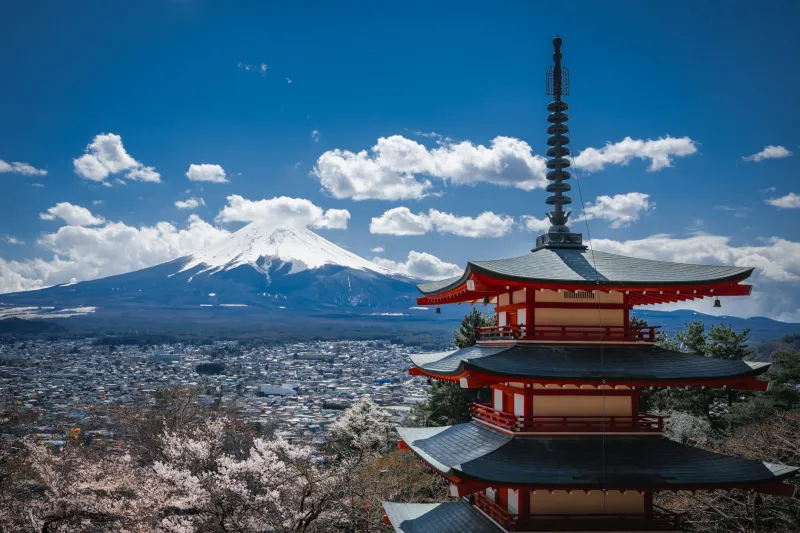
This part surprises a lot of first-timers. Arakurayama Sengen Park — home to that iconic view of the Chureito Pagoda framed against Mount Fuji with cherry blossoms in the foreground — isn't directly accessible from Tokyo by bullet train. You're looking at a combination of trains and/or a bus that takes roughly two to three hours from Shinjuku Station.
A round-trip ticket via the Fujikyuko Line from Otsuki runs around $20 to $35 USD depending on your rail pass situation. If you've purchased a Japan Rail Pass (which costs around $250 to $500 depending on duration), some of this may be covered, though the Fujikyuko Line isn't always included — so read the fine print.
Budget $40 to $60 for local transportation to and from the park, including incidentals like coin lockers and local buses.
Accommodations: The Peak Bloom Premium Is Real
Here's where the season bites hardest. Hotels in the Fujiyoshida area — the town closest to Arakurayama — see significant price spikes during peak bloom. A modest guesthouse or business hotel that might run $60 to $80 per night in the off-season can easily jump to $130 to $200 per night during late March and early April.
If you want a room with a Mount Fuji view, add another $50 to $100 on top of that — and book it the moment reservations open, because they sell out fast.
Most American visitors spend two to four nights in the region. For a three-night stay at a mid-range property, budget $450 to $650.
Staying in Tokyo and day-tripping is a popular alternative, but Tokyo hotels during cherry blossom season aren't cheap either. Expect to pay $180 to $350 per night for anything decent in a central neighborhood.
Food, Entry Fees, and the Small Stuff That Adds Up
Japan is remarkably affordable once you're on the ground — especially compared to European destinations. A solid ramen lunch near Fujiyoshida might cost $8 to $12. Convenience store dinners (and yes, they're genuinely good) can run $5 to $10. A sit-down kaiseki dinner at a nicer spot might be $40 to $80 per person.
Arakurayama Sengen Park itself charges a small entrance fee during cherry blossom season — typically around $2 to $3 USD — which is almost comically low given what you're getting access to. The climb to the Chureito Pagoda involves 398 steps, and that view costs you exactly nothing beyond the entrance fee and the cardio.
For food, drinks, and incidental spending, most travelers report spending $50 to $80 per day without trying particularly hard.
Over a four-day trip: $200 to $320.
The Hidden Cost Nobody Talks About: PTO
For American workers, this is often the most painful part of the equation. A meaningful Arakurayama trip — accounting for travel days, time zone recovery, and actual time at the mountain — realistically requires seven to ten days off work. For someone earning $60,000 a year, that's roughly $1,600 to $2,300 in foregone income, depending on whether their employer offers paid leave and how they calculate it.
This is a cost that rarely shows up in travel budget breakdowns, but it's real. And yet, when you talk to Americans who've made the trip, it's almost never the part they regret.
So What Does the Full Trip Actually Cost?
Let's put it together for a solo traveler on a realistic mid-range budget:
| Expense | Estimated Cost |
|---|---|
| Round-trip flight (economy) | $950 |
| Local transportation | $50 |
| Accommodations (3 nights) | $550 |
| Food and incidentals (4 days) | $260 |
| Rail pass (partial contribution) | $150 |
| Total out-of-pocket | ~$1,960 |
Add in the value of PTO used, and you're comfortably in the $3,000 to $4,500 range for most working Americans. Couples traveling together can split accommodation costs, bringing per-person totals down somewhat — but flights and PTO remain fixed.
How Does This Compare to Other Premium Travel Experiences?
For context, a week in the Maldives runs $4,000 to $8,000 per person. A peak-season safari in Kenya? $5,000 to $10,000. A Napa Valley wine weekend (not even a week) can easily hit $2,500 once you factor in resort fees, tastings, and meals.
By that measure, Arakurayama is actually a relative bargain in the premium travel category — especially given that Japan's food, local transport, and activity costs are genuinely lower than most Western destinations.
Why Americans Keep Saying It's Worth It
Here's the thing that doesn't show up in any spreadsheet: the return on experience. Travelers who've made the Arakurayama trip consistently describe it as categorically different from other expensive vacations. The combination of natural spectacle, cultural depth, and the sheer improbability of that view — blossoms, pagoda, Fuji, all at once — produces something that people report thinking about for years afterward.
It's not that they forgot what it cost. It's that the cost stopped mattering pretty quickly.
One traveler from Portland put it simply in a forum post that's been shared hundreds of times: "I've spent more on worse things."
For a trip that genuinely delivers on its promise — and Arakurayama, when the timing is right, absolutely does — that's probably the most honest cost-benefit analysis you're going to find.